Showing posts with label Books. Show all posts

Thursday, 9 December 2010

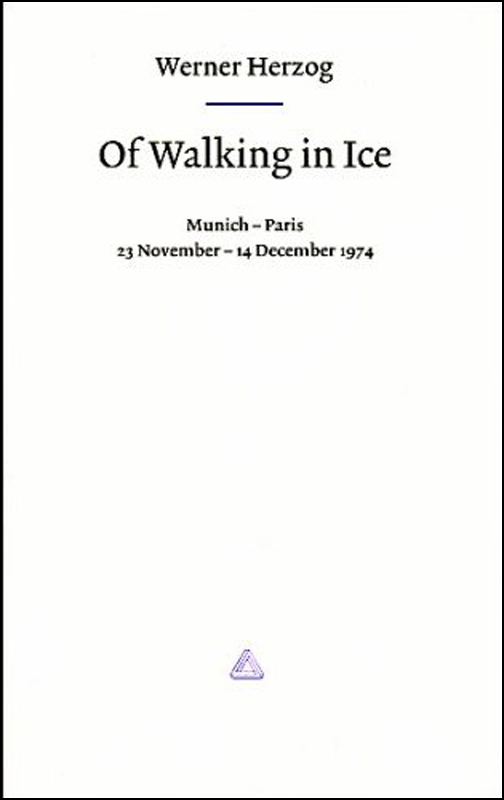
Of Walking in Ice (2007)

Author: WERNER HERZOG
Publisher: FREE ASSOCIATION

First published in 1978, this review is of the 2007 reprint.

Werner Herzog is one of the few directors who has continually emphasised the physicality of filmmaking. For Herzog the filmmaking process is as much an expression of brute strength and physical fitness, as it is mental and intellectual agility. In order to fully explore the musculature inherent in his attitude to the art Herzog has travelled the continents in search of harsh and dangerous terrains. This isn’t because of an irresponsible desire for risk taking in my view, but possibly to assuage the embarrassment Herzog might feel for having fallen into filmmaking as a career. In his manifesto for documentary cinema entitled The Minnesota Declaration Herzog states “Tourism is sin, and travel on foot virtue.” One of the key components of his ‘Rogue Film School’ is that “it is for those who travel on foot”, throughout Herzog’s writings and observations he has returned again and again to the idea of travelling on foot as a means to release the poetic qualities within, and to appreciate the landscape as something more than a scenic backdrop. This attitude reached its extreme apotheosis in the winter of 1973/4 when he embarked on a journey from Munich to Paris on foot, in order to visit the ailing German film scholar Lotte Eisner. Herzog believed that undertaking this epic travail in this manner would somehow lead to Eisner clutching to life, and to survive until he finally arrived. In this he was correct and Eisner would go on to live for several years.

Sunday, 31 October 2010

British Horror Cinema: A Literary Guide


The Wicker Man (Robin Hardy, 1973)

For decades the study of British horror cinema lay in an arid literary wasteland. During the period of the British horror films greatest commercial success (which can be put at 1957-76) just a single dedicated volume was published. This was David Pirie’s landmark polemical A Heritage of Horror: The English Gothic Cinema 1946 - 1972. Pirie’s was a solitary voice in an empty ocean. Ironically when the second edition of this book was published in 2007 it largely got overlooked in a market overcrowded with yet more substandard books on Hammer Film Productions. British horror had been sustained through the 1980’s and first half of the 1990’s by genre specific magazines and fan publications (the best of which still remains Little Shoppe of Horrors) before a relative deluge of material flooded the market. Much of it was of poor quality, for example of the huge number of books dedicated to Hammer, I consider only five of value. The increasing popularity of horror cinema on undergraduate degree courses, and the continued ascendancy of the study of cult film has enabled publishers to take advantage. But the question still remains; where to begin? This guide is intended to separate the wheat from the chaff, and to offer the best overall library of books for the appreciation of British horror. There are over one hundred books on the subject, this guide reduces that number to fifteen. This will probably be a contentious selection, but I hope it helps people to make informed decisions, that will also hopefully save them a few pounds or dollars.

Wednesday, 13 October 2010

La Dolce Morte: Vernacular Cinema and the Italian Giallo Film

Author: MIKEL J. KOVEN
Publisher: SCARECROW PRESS
Publication Date: 28th October 2006

Despite ever greater prominence in the age of DVD popular Italian cinema from the 1960’s, 70’s, and 80’s has still received relatively sparse coverage in the literary world. With the continued rise in the study of cult film (and its acceptability within academic circles) this is an oversight that needs redressing. Aside from a handful of articles (one particularly important one is Leon Hunt’s A (sadistic) Night at the Opera: Notes on the Italian Horror Film from a 1992 edition of Velvet Light Trap) gialli have mostly found themselves discussed as part of auteur driven studies of the most visible directors of the form. But I have long believed that this durable cycle of films is deserving of a multitude of critical approaches, and to file them away as part of some half assed fan worship auteur nonsense does them a great disservice. Mikel J. Koven’s study is important for a variety of reasons. It represents the first occasion that gialli have been treated to a book length study in the English language and Koven’s thesis concerns itself as much with the audience of these films as it does with the formal properties that make the films so distinctive in the first place.

Thursday, 29 April 2010

The Video Nasties: Bibliography and Useful Sources


I have finally managed to escape the bloodthirsty cannibals with my life and my penis intact, and have left the jungle landscape of the Video Nasties far behind me. The zombies were unsociable, the madmen with drills were poor company, and the avenging females made for disastrous dates. It has been a challenging trawl through the cinematic sewer and the reviews that appeared this month on The Celluloid Highway represent only a fraction of the films I tortured myself with. Some of those films might emerge on these pages in later months…so beware. Those that did make it on the highway did so because they impressed me in some way. Either for being surprisingly well made, a catalogue of absurdity or downright offensive. In conclusion I will provide here a guide to some of the books and websites that are useful aids to picking apart the complex arguments and histories that make up this fascinating period in British film history.

Friday, 22 January 2010

Agitator: The Cinema of Takashi Miike

Writer: TOM MES
Publisher: FAB PRESS
Year: 2003

Since the advent of DVD the distribution of Japanese films in the UK market has improved markedly. Whilst distributors like the BFI, Tartan and Eureka continue to do good work in releasing major films by major directors, contemporary Japanese cinema (say from 1995 to the present) still remains an area of potential limbo. The films of Takashi Miike are representative of this. It doesn’t help that Miike is so prolific - regularly seeing four to six films released in a calendar year, and whilst UK audiences can enjoy his major works, a large swathe (most specifically his more recent work) remains unavailable here. It therefore becomes night on impossible to join the dots of meaning between his films and construct any sense of thematic continuity. Progressions of form and style and his attitude to genre are difficult to decipher when one only sees a handful of works, and despite academia’s best efforts, auteur constructions of filmmakers continue unabated.

Tuesday, 19 January 2010

Conquest of the Useless

Writer: WERNER HERZOG
Publisher: ECCO PRESS
Year: 2009

Between 1979 and 1982 Werner Herzog embarked on an epic filmmaking odyssey in the inhospitable and will sapping confines of the Peruvian jungle. The outcome was the film Fitzcarraldo, most famous for an extended sequence in which the titular character played by Klaus Kinski takes advantage of tribal myths and persuades hundreds of Indians to help him drag a steamship over a mountain. Herzog insisted on performing this without the aid of special effects, fake boats or on a set - depending on your view the metaphorical significance of this act defined the visionary nature of the film or was just the folly of an unhinged megalomaniac. The difficulties the filmmakers faced is now the stuff of legend and were documented heavily in the press coverage of the time and in the documentary Burden of Dreams (1982) directed by Les Blank. But over a quarter of a century later Herzog himself has chosen to wade in with is own interpretation of the madness in the jungle, by publishing his diaries of the whole experience. Perhaps Herzog is aware that his stock has risen to its pinnacle in recent years thanks to Grizzly Man (2005) and Rescue Dawn (2006), and there does seem a bit of opportunism about publishing a book about events that are so well documented in other sources. However it soon becomes clear that Herzog’s eloquent turn of phrase and penchant for bizarre similes will afford the reader a unique experience.

Related Posts with Thumbnails