Showing posts with label Werner Herzog. Show all posts

Thursday, 14 February 2013

The Unprecedented Defence of the Fortress Deutschkreuz (1967)


Dir: WERNER HERZOG
Country: WEST GERMANY

The Unprecedented Defence of the Fortress Deutschkreuz is a short fourteen minute film written, directed, and produced by Bavaria’s finest filmmaker Werner Herzog. It was his third film, following on from his debut short Herakles (1962) and the mysterious and totally obscure Game in the Sand (1964). The latter is a film that Herzog has consistently refused to distribute, and will almost certainly remain hidden, owning to subject matter that still leaves the director disturbed. Fortress Deutschkreuz was Herzog’s first attempt at fiction, and as such it can be seen as something of a dress rehearsal for his first feature film Signs of Life which would follow in 1968. Both films explore the psychology of warfare, as the protagonists do battle with imaginary enemies. Signs of Life benefited tremendously from its beautiful Crete locations, brought vividly to monochrome life by the cinematography of Thomas Mauch, and the brilliantly unhinged performance of Peter Brogle as the brittle fantasist Stroszek. Fortress Deutschkreuz by contrast is still a little uneven and crude in places and the quality of the transfer I viewed does not aid its cause. However it does set up a satirical attitude to warfare that Herzog would develop and refine throughout his career.

Friday, 8 February 2013

No One Will Play With Me (1976)


Dir: WERNER HERZOG
Country: WEST GERMANY

This unusual and obscure little film from Werner Herzog emerged in between his two feature films The Enigma of Kaspar Hauser (1974) and Heart of Glass (1976). The former is quite rightly lauded as one of Herzog’s finest achievements, and introduced the world to the bizarre talents of the non-professional actor Bruno S. The latter was a challenging fable of prophecy and apocalypse, a highly stylised and visionary film in which the director famously hypnotised the majority of the cast members. It seems odd that Herzog would return to the short film at this stage in his career. His previous short film was made seven years before and was entitled Precautions Against Fanatics (1969), and in that time he had achieved his international breakthrough with feature films like Aguirre: Wrath of God (1972), the aforementioned Kaspar Hauser, and critically acclaimed documentaries such as Land of Silence and Darkness (1971) and The Great Ecstasy of the Woodcarver Steiner (1974), both of which were made for West German television, but achieved wider distribution due to the directors new found fame.

Sunday, 3 February 2013

Herakles (1962)

Dir: WERNER HERZOG
Country: WEST GERMANY


This short nine minute film would be totally insignificant were it not for the fact that it marked the debut to filmmaking of Werner Herzog. The barmy Bavarian was a mere twenty years old when he wrote, directed, produced, and edited this somewhat amateurish effort. It is fair to say that Herakles was an exercise; an experiment on Herzog’s part to see if he could actually make a film. But even at this early stage Herzog’s decision to shoot on 35mm film shows that he had ambitions that far exceeded the humble nature of this production. But Herakles was an instructive lesson, especially for a young man who largely existed in a world without cinematic reference points, and whose influences were extremely limited. In this film Herzog explores the art of editing, and although Herakles is little more than an editorial exercise, it does contain a few images that will be of interest to Herzog enthusiasts. 


Thursday, 9 December 2010

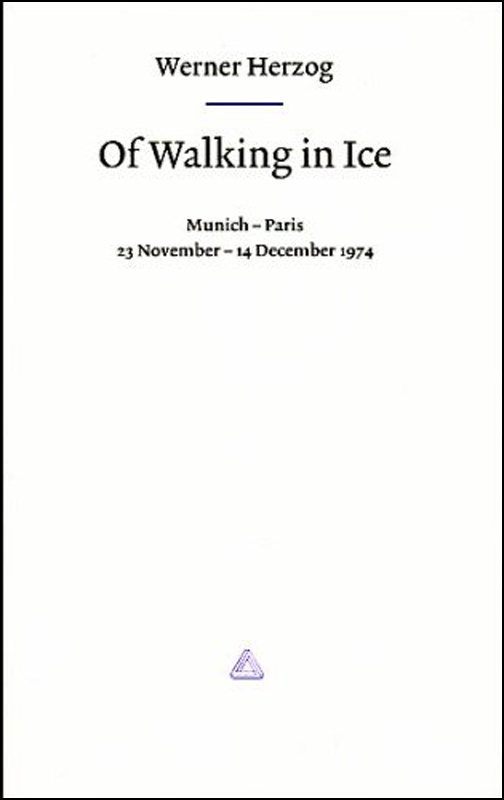
Of Walking in Ice (2007)

Author: WERNER HERZOG
Publisher: FREE ASSOCIATION

First published in 1978, this review is of the 2007 reprint.

Werner Herzog is one of the few directors who has continually emphasised the physicality of filmmaking. For Herzog the filmmaking process is as much an expression of brute strength and physical fitness, as it is mental and intellectual agility. In order to fully explore the musculature inherent in his attitude to the art Herzog has travelled the continents in search of harsh and dangerous terrains. This isn’t because of an irresponsible desire for risk taking in my view, but possibly to assuage the embarrassment Herzog might feel for having fallen into filmmaking as a career. In his manifesto for documentary cinema entitled The Minnesota Declaration Herzog states “Tourism is sin, and travel on foot virtue.” One of the key components of his ‘Rogue Film School’ is that “it is for those who travel on foot”, throughout Herzog’s writings and observations he has returned again and again to the idea of travelling on foot as a means to release the poetic qualities within, and to appreciate the landscape as something more than a scenic backdrop. This attitude reached its extreme apotheosis in the winter of 1973/4 when he embarked on a journey from Munich to Paris on foot, in order to visit the ailing German film scholar Lotte Eisner. Herzog believed that undertaking this epic travail in this manner would somehow lead to Eisner clutching to life, and to survive until he finally arrived. In this he was correct and Eisner would go on to live for several years.

Sunday, 25 July 2010

Little Dieter Needs to Fly (1997)

Dir: WERNER HERZOG
Country: FRANCE/UK/GERMANY

Like the ski flier Walter Steiner in Herzog’s earlier documentary The Great Ecstasy of  Woodcarver Steiner (1974) Dieter Dengler had one overriding dream as a child - this dream was to fly. That this dream would take Dengler from the poverty and hunger struck ruins of post war Bavaria, to the streets of New York, to the US navy, and eventually to sixth months in a Vietnamese prisoner of war camp speaks volumes for his will and determination to achieve his life long ambition. The latter episode of course was totally unpredicted, but part of Dengler’s charm is the naïve innocence that led to him joining the navy and eventually piloting an aircraft. In many ways for Dengler the Vietnam War was simpler the enabler of his dream. He had little concept or awareness of the human cost beneath the green canopy of the jungle, but just two hours into his first flight he found himself within that terrain and plunged into a fight for survival. Herzog contextualises this with the inclusion of some inspired stock footage. The images of the jungle landscape exploding in slow motion were recycled for his feature film based on Dengler’s experiences Rescue Dawn (2006) and they possess an odd and haunting poetry. In contrast the footage of jungle survival techniques put out by the military in the 1960’s is laughable and painfully ironic when one thinks of Dengler’s ordeal.

Tuesday, 20 July 2010

Werner Herzog Eats His Shoe (1980)

Dir: LES BLANK
Country: USA

The Criterion Collection’s DVD of Burden of Dreams (1982) is an excellent package offering a wealth of important contextual information. This includes commentary tracks from directors Werner Herzog and Les Blank, Blank’s informative and absorbing diary of his time in the Peruvian jungle shooting his documentary, a lengthy retrospective interview with Herzog, and most priceless of all a short 20 minute documentary made by Blank in 1980 called Werner Herzog Eats His Shoe. Any release of short documentary material either by or about Herzog is a mini event in itself, and due to the films content and its title this has always been an exotic and long sought after item for those seeking out Herzog related material. Herzog’s militant attitude to filmmaking is given an opportunity to flourish in this short piece which was filmed during one of numerous breaks in the fragmented and troubled production of Fitzcarraldo (1982). At some point in the late 1970’s Herzog made the bold assertion that he would eat his shoe if young filmmaker Errol Morris succeeded in his quest to make a film. This bet was both an inspiration to Morris and an example of Herzog’s attitude to the importance of individuals battling the odds to achieve their vision. Naturally Morris succeeded and the film opens with Herzog flying in to attend a screening of Gates of Heaven (1978) and to make good on his shoe eating bet.

Sunday, 18 July 2010

Burden of Dreams (1982)

Dir: LES BLANK
Country: USA

Burden of Dreams is a remarkable documentary that in many ways holds a greater prominence than the film it is documenting. The filming of Werner Herzog’s Fitzcarraldo (1982) was becoming a legend while it was happening, but Les Blank’s documentary helps to clear aside the mythologizing in much the same way that Herzog’s army of extras cleared away a mountain pass for the central metaphor of the film. Blank’s camera helps to humanise the proceedings and documents in unflinching detail the heavy price that numerous people paid in service of Herzog’s dream. Dreams hang heavily in the air like the humid temperatures of the Peruvian jungle, and this is a document about the futility of attempting to capture a reality on screen that exists within the fevered realms of a dreamscape. The ‘making of’ documentary has become a debased form in the modern age of DVD with producers employing film crews dedicated to producing bland and generic featurettes during the making of the film for the sell through market. These artless self-centred ego trips are barely watchable, but it means that the cost of producing material for the DVD is absorbed into the budget of the film. The genius of Burden of Dreams, and the reason such a film wouldn’t be made now, is that it concerns itself with things other than the making of the film. Blank’s documentary possesses an organic and improvised feel which uses the events surrounding the production of Fitzcarraldo as an anchor for a very inquiring camera.

Friday, 16 July 2010

Stroszek (1977)

Dir: WERNER HERZOG
Country: WEST GERMANY

One of the meta-narratives or major thematic concerns that preoccupied the generation of filmmakers that made up what scholars termed ‘New German Cinema’ was coming to terms with, and exploring, the cultural colonisation wrought on West Germany in the aftermath of World War Two by America. Wim Wenders approached the subject from the perspective of cinema itself in The American Friend (1977) and Kings of the Road (1976) and throughout his career revised the form of the road movie for a generation of alienated Europeans. Rainer Werner Fassbinder opted to explore the question through a reconstitution of Hollywood genre - most notably the Sirkian melodrama of films such as Fear Eats the Soul (1974). Whilst the films of these two ‘New German’ heavyweights were by no means conventional, Werner Herzog’s single contribution to this ongoing narrative is a truly wacky and oddball take on the subject. Stroszek was Herzog’s sixth fictional feature film and it was his first, and to date last, to be set (albeit partially) in contemporary West Germany. Up to this point Herzog had preferred to set his films in the past and in some cases on other continents, and used the storytelling method of allegory, metaphor and symbolism, to make comments on Germany and its recent past. In Stroszek Herzog concocted a narrative (partially based on the childhood experiences of Bruno S.) that enabled him to formulate his view at the time of both West Germany and America. Like most filmmakers of that generation Herzog’s vision is deeply ambivalent, but ultimately he suggests that all countries are alike in the manner in which they can crush the life out of their citizens - the only difference is in the method.

Tuesday, 13 July 2010

Woyzeck (1979)

Dir: WERNER HERZOG
Country: WEST GERMANY

Werner Herzog is well known for his daring approach to filmmaking and for his commitment to taking risks in service of his never ending search for the ‘ecstatic truth’ within an image. But in many ways his boldest filmmaking move occurred during 1978/9 when he made two films back to back that were based on pre-existing material highly venerated in Germany. The first was a remake of F.W. Murnau’s silent expressionistic horror classic Nosferatu (1922) with Klaus Kinski playing the eponymous bloodsucker. The second was the trickier proposition of adapting Georg Buchner’s unfinished play Woyzeck - a demanding work requiring the steely nerve of a major actor to cope with the harrowing treatment the character endures. With just a week off after the completion of shooting on Nosferatu Kinski stepped up to the plate and 18 days later the shooting of Woyzeck was complete and Kinski was able to have his nervous breakdown in peace. The speed with which the film was completed has to be admired and shows an economy of filmmaking from Herzog which has remained unrepeated. To add yet more exhaustion and trauma to the characterisation of Woyzeck Herzog insisted on extremely long unbroken takes - there are in fact only 27 cuts in the whole movie! While this was undoubtedly a major challenge to the actors, it enabled Kinski to probably give the greatest performance of his career.

Sunday, 11 July 2010

La Soufriere (1977)

Dir: WERNER HERZOG
Country: WEST GERMANY

The subtitle to this short thirty minute documentary from Werner Herzog is 'waiting for an inevitable catastrophe'. Within that statement lies an aspect of Herzog’s approach to cinema that has helped to create a mythology of reckless risk taking, a sense that danger is a fundamental aspect in his never ending search for new images. Although an impression of catastrophe is not inevitable in Herzog’s cinema, there is always an echo within the frame of the extremities and hardships undertaken to achieve the finished product. More so than any other filmmaker, the act of filmmaking itself becomes an essential aspect to understanding the fictional world Herzog creates. The same idea can be usefully applied to his documentaries - but La Soufriere is surely the one in which the spectre of death and destruction looms most palpably in every frame. In late 1976 Herzog along with his two cameramen Jorg Schmidt-Retwein and Edward Lachman travelled to the Caribbean island of Guadeloupe, an island that had been evacuated due to the imminent explosion of the volcano La Soufriere. However a handful of peasants had remained on the island, despite claims by volcanologists that to do so would mean certain death. Intrigued by this attitude to impending death Herzog was determined to interview these men to get a better understanding of their cavalier approach to life.

Wednesday, 7 July 2010

Fata Morgana (1971)

Dir: WERNER HERZOG
Country: WEST GERMANY

Fata Morgana is the most oblique and inscrutable of Werner Herzog’s early films. It is neither a work of fiction, nor a documentary. But exists within a liminal space between these two spheres of representation. It is totally devoid of plot, employing none of the narrative conventions of Hollywood cinema, preferring to approach time and space from a position of non linearity rather than cause and effect. The editing strategies employed in post-production emphasise this attitude towards time, and the result is a film that has the timeless quality of a myth or a fable. Its position as myth is clearly signposted by Herzog’s inclusion of the Popol Vuh (a Mayan creation myth) which is narrated over the images by German film historian Lotte Eisner. This is further confirmed by a three part structure which gives the film the appearance of a meditative and free flowing essay. The three parts are titled Creation, Paradise and The Golden Age and are an echo of Herzog’s early conception of the film as a science-fiction document of alien visitors recording their findings of a long dead civilisation. The imagery that Herzog selects however often undermines the chapter it is within - The Golden Age for example has a number of deeply ironic and unspeakably sad scenes, and Paradise offers us the vista of a blasted landscape crushed under the unyielding glare of the sun. There is subsequently a deep contradiction at the heart of Fata Morgana, a contradiction that seems to exist within most of Herzog’s films, and which makes the viewing experience an oddly disquieting one.

Monday, 5 July 2010

Heart of Glass (1976)

Dir: WERNER HERZOG
Country: WEST GERMANY

aka:
Herz Aus Glas

Heart of Glass is a challenging and demanding film, but almost certainly the clearest statement made by Herzog about the insanity and visionary nature of a fever dream. This time Herzog is concerned with collective hysteria as he charts the gradual breakdown and dissolution of a small community in late 18th century Bavaria. The centrepiece of the village is a factory that produces ruby coloured glass, but when the man entrusted with the secret of the ruby glass dies, taking the secret with him to the grave, the village is plunged into an apocalyptic anarchy that ends with madness and destruction. Herzog opens the film with a beautifully composed shot of a herdsman with his back to camera. An ethereal mist hangs in the cold air, which gives the image an unsettling and disturbing resonance. The sound of Swiss yodellers on the soundtrack only adds to the odd sense of eerie timelessness which opens the film. The herdsmen is Hias (Josef Bierbichler), a man who also possesses the gift of prophecy. What follows is a prophecy of destruction and rebirth, and Herzog fills the screen with one haunting image after another. The clouds resemble rivers in the sky, a waterfall becomes a hypnotic conduit to another plane of existence, and a pool seethes and bubbles as though eager to eject life into a newly formed world. All the while the hypnotic tones of Hias speak a litany of grave pronouncements amid an ever increasing culture of impending doom. There is something revelatory in this imagery, and although it is shot through with destructive pessimisms the music of Popol Vuh creates an uplifting counterpoint to the catastrophe that Hias foresees. There is an odd contradiction here, one which doesn’t resolve itself at all in the film, and makes Heart of Glass a very unsafe viewing experience.

Sunday, 4 July 2010

Into the Mind of Werner Herzog...and Klaus Kinski!


I believe the common denominator of the Universe is not harmony, but chaos, hostility and murder. (Grizzly Man, 2005)

If you switch on television it's just ridiculous and its destructive. It kills us. And talk shows will kill us. They kill our language. So we have to declare holy war against what we see every single day on television. Commercials and – I think there should be real war against commercials, real war against talk shows, real war against "Bonanza" and "Rawhide", or all these things. (Werner Herzog Eats His Shoe, 1980)

There are deeper strata of truth in cinema, and there is such a thing as poetic, ecstatic truth. It is mysterious and elusive, and can be reached only through fabrication and imagination and stylization. (Minnesota Declaration, 1999)

Life in the oceans must be sheer hell. A vast, merciless hell of permanent and immediate danger. So much of a hell that during evolution some species—including man—crawled, fled onto some small continents of solid land, where the Lessons of Darkness continue. (Minnesota Declaration, 1999)

The kinds of landscape I try to find in my films...exist only in our dreams. For me a true landscape is not just a representation of a desert or a forest. It shows an inner state of mind, literally inner landscapes, and it is the human soul that is visible through the landscapes presented in my films. (Herzog on Herzog, 2002)

Coincidences always happen if you keep your mind open, while storyboards remain the instruments of cowards who do not trust in their own imagination and who are slaves of a matrix... If you get used to planning your shots based solely on aesthetics, you are never that far from kitsch. (Herzog on Herzog, 2002)

It is my firm belief, and I say this as a dictum, that all these tools now at our disposal, these things part of this explosive evolution of means of communication, mean we are now heading for an era of solitude. Along with this rapid growth of forms of communication at our disposal— be it fax, phone, email, internet or whatever— human solitude will increase in direct proportion. (Herzog on Herzog, 2002)

KINSKI ON HERZOG

Herzog is a miserable, hateful, malevolent, avaricious, money-hungry, nasty, sadistic, treacherous, cowardly creep...he should be thrown alive to the crocodiles! An anaconda should strangle him slowly! A poisonous spider should sting him and paralyze his lungs! The most venomous serpent should bite him and make his brain explode! No—panther claws should rip open his throat—that would be much too good for him! Huge red ants should piss into his lying eyes and gobble up his balls and his guts! He should catch the plague! Syphilis! Yellow fever! Leprosy! It's no use; the more I wish him the most gruesome deaths, the more he haunts me. (Kinski Uncut, 1996)


His speech is clumsy, with a toad like indolence, long winded, pedantic, choppy. The words tumble from his mouth in sentence fragments, which he holds back as much as possible, as if they were earning interest. It takes forever and a day for him to push out a clump of hardened brain snot. Then he writhes in painful ecstasy, as if he had sugar on his rotten teeth. A very slow blab machine. An obsolete model with a non-working switch— it can't be turned off unless you cut off the electric power altogether. So I'd have to smash him in the kisser. No, I'd have to knock him unconscious. But even if he were unconscious he'd keep talking. Even if his vocal cords were sliced through, he'd keep talking like a ventriloquist. Even if his throat were cut and his head were chopped off, speech balloons would still dangle from his mouth like gases emitted by internal decay. (Kinski Uncut, 1996)

Friday, 2 July 2010

The Great Ecstasy of Woodcarver Steiner (1974)

Dir: WERNER HERZOG
Country: WEST GERMANY

aka:
Die große Ekstase des Bildschnitzers Steiner

This magnificent documentary is a both a study of sporting endeavour and a journey into the psychology of a man willing to risk his very existence to attain his life long dream of flight. The Swiss ski jumper/flier Walter Steiner is probably Werner Herzog’s perfect protagonist. Steiner is an exceptional and introverted figure, a man on the edge of the world, who lives a life of contrasting and conflicting emotions. On the one hand Steiner lives a simple rural life in which he spends his days quietly carving objects out of wood. He appears unassuming and shy, somewhat awkward and self conscious in front of the camera, although when left to his thoughts is surprisingly eloquent and poetic. Herzog deftly emphasises the mundane aspects of Steiner’s life which allows for a far greater impact when we see Steiner launching himself at ridiculous speeds into the alpine skies and clearing 170 meters. The film opens with this image - a beautiful but eerie shot of Steiner in slow motion, his mouth agape, the mountainous backdrop still and implacable and the ethereal music of Popol Vuh giving the shot a resonance and grandeur that slips it into the realm of the ecstatic.

Thursday, 1 July 2010

Werner Herzog Month - An Introduction

This month sees The Celluloid Highway dedicate itself to one of the world’s most idiosyncratic and unique filmmakers Werner Herzog. From the moment I saw a rare screening of Aguirre: The Wrath of God (1972) on BBC 2 in 2000 I have been hooked on this odd man from Bavaria. The sublime images captured by Herzog in Aguirre imprinted themselves on my mind, and for the first time I saw the importance and value of natural landscapes to the creation of highly symbolic and metaphorical statements on the human condition. But little did I know that viewing this film was merely the first step of the process - the discovery of the rigours and chaos of the shoot and of the maniacal ravings of Klaus Kinski, and the sacrifices made by Herzog and his cast and crew too appease Kinski only increased my admiration for the softly spoken Bavarian. As the film concluded and Herzog’s camera circled the raft on which the isolated Aguirre continued to proclaim his dominion over all creatures I thought this was a statement on madness and ego that could never be matched - I was wrong!

Monday, 8 February 2010

The Wild Blue Yonder (2005)

Dir: WERNER HERZOG
Country: GERMANY, FRANCE, AUSTRALIA, UK

German director Werner Herzog has made a career out of an intriguing and often controversial fusion of fiction and documentary. His fictional feature films such as Aguirre: Wrath of God (1972) and Fitzcarraldo (1982) foreground the hardship, toil and risk of their filming and come across as much as essays on the perils and difficulties of the filmmaking process as they do works of poetic art. Likewise, documentaries such as The Ecstasy of the Woodcarver Steiner (1974) and Little Dieter Needs to Fly (1997) have all the embellishments and stylisations one would expect in a feature film.

Wednesday, 3 February 2010

Aguirre: Wrath of God (1972)

Dir: WERNER HERZOG
Country: WEST GERMANY, PERU, MEXICO.

aka:
Aguirre, der Zorn Gottes

In 1972 German filmmaker Werner Herzog travelled into the dark heart of the claustrophobic Peruvian jungle, armed with a camera, a skeleton crew and an army of Indian extras in order to film Aguirre: Wrath of God, an astonishing work of film art that would herald his international breakthrough, and eventually become one of his most celebrated works. On one level Aguirre is an epic adventure film, and as such it has a linear and easy to follow narrative. This linearity marked a break from Herzog’s past efforts. Herzog also cast a recognisable international figure in the shape of Klaus Kinski as the eponymous plotter Aguirre. Therefore its clear that this was a slightly more commercial venture from a director who previously seemed more allied with an Avant-garde style of filmmaking.

Tuesday, 19 January 2010

Conquest of the Useless

Writer: WERNER HERZOG
Publisher: ECCO PRESS
Year: 2009

Between 1979 and 1982 Werner Herzog embarked on an epic filmmaking odyssey in the inhospitable and will sapping confines of the Peruvian jungle. The outcome was the film Fitzcarraldo, most famous for an extended sequence in which the titular character played by Klaus Kinski takes advantage of tribal myths and persuades hundreds of Indians to help him drag a steamship over a mountain. Herzog insisted on performing this without the aid of special effects, fake boats or on a set - depending on your view the metaphorical significance of this act defined the visionary nature of the film or was just the folly of an unhinged megalomaniac. The difficulties the filmmakers faced is now the stuff of legend and were documented heavily in the press coverage of the time and in the documentary Burden of Dreams (1982) directed by Les Blank. But over a quarter of a century later Herzog himself has chosen to wade in with is own interpretation of the madness in the jungle, by publishing his diaries of the whole experience. Perhaps Herzog is aware that his stock has risen to its pinnacle in recent years thanks to Grizzly Man (2005) and Rescue Dawn (2006), and there does seem a bit of opportunism about publishing a book about events that are so well documented in other sources. However it soon becomes clear that Herzog’s eloquent turn of phrase and penchant for bizarre similes will afford the reader a unique experience.

Monday, 18 January 2010

Encounters at the End of the World (2007)

Dir: WERNER HERZOG
Country: USA

Eccentric Bavarian filmmaker Werner Herzog continues to defy categorisation - which is some achievement after forty seven years of making films. His movies are never less than inscrutable, perplexing and enigmatic. Even when Herzog deals in more straightforward subject matter he brings to it an otherworldly sensibility. Encounters at the End of the World is a mystifying and unfathomable experience in large part due to an episodic structure that mirrors the itinerant souls that find themselves encamped at the end of the world. Herzog was inspired to shoot a documentary film in Antarctica by the unearthly underwater footage shot by diver and musician Henry Kaiser. A good deal of this found footage appears in Herzog’s bizarre science-fiction parable The Wild Blue Yonder (2005) doubling as a strange and ethereal alien world. Herzog’s Antarctic adventure was approved by the National Science Foundation, and he was determined not to treat the landscape in the romanticised sentimental fashion displayed in March of the Penguins (2005). Instead he sets about asking the peculiar questions of nature and life that we have come to expect of him, and treats the landscape with a reverence bordering on the spiritual. 

Related Posts with Thumbnails