Showing posts with label Giallo. Show all posts

Monday, 24 September 2012

Calling All Police Cars (1975)

Dir: MARIO CAINO
Country: ITALY

AKA:
...a tutte le auto della polizia
Without Trace

Calling All Police Cars is one of the most notable obscurities to cross my desk in recent months. I say notable because its position within the landscape of popular Italian cinema of the 1970’s is truly undeserved. I have yet to read a negative assessment of this film, but the problem is being able to actually find any critical writing on it at all. The age of DVD has been particularly kind to some films and directors from this era, in some cases richly deserved, in others far from it. Mario Caino appears to be a director that frequently slips through the net, though the few films of his I have seen, easily stand up to many of his contemporaries. Caino is perhaps best known to fans of cult cinema for his 1965 gothic horror picture Nightmare Castle, which featured British actress Barbara Steele in dual roles, beautiful cinematography by Enzo Barboni, and a fitting score by Ennio Morricone. This distinctive contribution to Italian cinema’s gothic horror cycle was not really followed up though, as Caino found a productive niche in the popular and profitable spaghetti western cycle; titles include Ringo; Face of Revenge (1967, featuring Anthony Steffen), Train for Durango (1968) and My Name is Shanghai Joe (1973, featuring Klaus Kinski). Caino further proved his skill at adapting to different genres with Milano Violenta (1976, aka Bloody Payroll) and the Henry Silva starring Weapons of Death (1977), both of which were assured entries in the Euro-Crime cycle. A departure into the vile and sleazy world of Nazisploitation resulted in Caino’s most controversial film Nazi Love Camp 27 (1977), which, despite its subject matter, was still quite effective.

Friday, 1 June 2012

Your Vice is a Locked Room and Only I Have the Key (1972)

Dir: SERGIO MARTINO
Country: ITALY

AKA:
Excite Me
Eyes of the Black Cat
Gently Before She Dies

Your Vice is a Locked Room and Only I Have the Key (it’s a bit of mouthful, but still an awesome title) was Italian filmmaker Sergio Martino’s fourth attempt to concoct excitement and entertainment within the highly stylised environs of the giallo. His previous three The Strange Vice of Mrs. Wardh (1971), The Case of the Scorpion’s Tail (1971), and All the Colours of the Dark (1972) showed a filmmaker willing to develop and expand upon the conventions he was working in. The Strange Vice of Mrs. Wardh wore its influences a little too noticeably, but was still a confident first effort. The Case of the Scorpion’s Tail offered refinement, and was a solid progression on the previous film, if still somewhat overshadowed by its mimicry of others. The culmination of Martino’s vision came in All the Colours of the Dark; his first giallo to stand firmly on its own two legs, show some innovation, and offer the possibility of a unique brand of gialli with the indelible stamp of Martino’s personality. With this in mind Your Vice…has to be considered something of a retrograde step, and while some may cite the films cross pollination of gothic modes of address within the form of the giallo as evidence of innovation, one only need look to the marvellously baroque The Night Evelyn Came out of the Grave (1971), which appeared a year before Martino’s film, and is far superior on almost every level.

Thursday, 12 April 2012

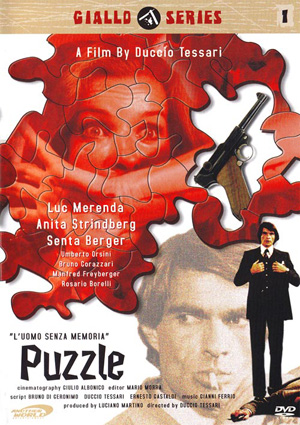
Puzzle (1974)

Dir: DUCCIO TESSARI
Country: ITALY

AKA:
L'uoma Senza Memoria
Man Without a Memory

Having carved himself a niche in the ripped torso’s, tests of strength, and myth and fantasy of the peplum, and then confidently leaped into the saddle for the dusty heat and cynical violence of the spaghetti western, it was inevitable that director Duccio Tessari would eventually find himself staring into a bottle of J&B Whiskey and making himself at home amid the chunky turtle neck sweaters, blazers, and camp penthouse apartments of the giallo. But like Fernando Di Leo, Enzo G. Castellari, and Tonino Valerii, directors more commonly associated with other popular cycles, Dessari’s journey into the jet-set cosmopolitanism of the giallo was brief, but in one case at least, very memorable. This memorable addition to the fabric of the cycle was in actual fact his first foray, the beautiful and evocatively titled The Bloodstained Butterfly (1971). Tessari’s means of stylistic expression was significantly more restrained in this example, and the broad violent punctuation marks represented by the set piece are barely in evidence. Instead Tessari very wisely adopted a more simplified filmmaking approach which serves the tightly plotted narrative, instead of overwhelming it. He was aided in his cause by a fine score from Gianni Ferrio, expert cinematography by Carlo Carlini, and a solid lead performance by Helmut Berger.

Wednesday, 21 March 2012

The New York Ripper (1982)

Dir: LUCIO FULCI
Country: ITALY

A viewing of Lucio Fulci’s scandalous The New York Ripper has almost become something of a rites of passage for horror fans looking too experience the more extreme and unpleasant end of the spectrum. It wields a strange repulsive fascination not dissimilar to controversial ‘Video Nasties’ such as Cannibal Holocaust (1980) and I Spit on Your Grave (1978); to see them, and to own them in uncut prints, is seen as something of a badge of honour in some quarters. Fortunately such juvenilia are not to be found on these pages, and my encounter with this repugnant artefact came as a result of a piece of research into British film censorship. It’s not a film I would watch by choice, but then who would? Although it is often situated within the giallo cycle I find this position to be nominal at best. By 1982 the giallo was no longer a major force of influence within the horror genre, if anything gialli were absorbing influences from elsewhere; most notably from the American slasher film. A reversal of positions as it was, and one which would have a damaging effect on the giallo as films increasingly took on the appearance of cut rate slasher flicks. The New York Ripper is a very good example of this trend. Its prevailing influence was William Lustig’s squalid Maniac (1980) rather than The Bird with the Crystal Plumage (1970) or Deep Red (1975).

Sunday, 26 February 2012

What Have You Done To Solange? (1972)

Dir: MASSIMO DALLAMANO
Country: ITALY/WEST GERMANY

AKA:
Cosse avete fatto a Solange?
Who's Next?
Solange
Terror in the Woods
The School that Couldn't Scream
The Secret of the Green Pins

In January 2011 I dedicated an entire month of The Celluloid Highway to the Italian giallo. Of the films I reviewed that month I was most impressed by Massimo Dallamano’s 1974 entry What Have They Done to Your Daughters? I particularly enjoyed the confident manner in which the narrative strategies of the giallo were fastened to the high octane thrills and spills one would commonly associate with the poliziotesschi. From 1946 to 1966 Dallamano carved out a career as a cinematographer, the culmination of which was his work on A Fistful of Dollars (1964) and For a Few Dollars More (1965). But as a director we are only left with the merest of legacies. He only directed twelve feature films before his untimely death in a car accident in late 1976. On the strength of Venus in Furs (1969) and the aforementioned What Have They Done to Your Daughters? I was determined to explore as many of his dozen films as I could. Unfortunately I was waylaid on this quest and Dallamano was filed away for future reference. A year later I finally got the opportunity to screen his first giallo What Have You Done to Solange? and was immediately surprised (and not to mention a little weary) of the unanimous praise the film has received in critical circles. Only a select band of gialli have reviewed as well as Solange. I expected the film to struggle to live up to its reputation, but I’m pleased to report this is one film that is deserving of its current status amid the highest echelon of the cycle.

Wednesday, 1 February 2012

Knife of Ice (1972)

Dir: UMBERTO LENZI
Country: ITALY/SPAIN

AKA:
Il coltello di ghiaccio
Silent Horror

I should start this review by saying I’m not a big admirer of the films of Umberto Lenzi. I’m well aware of the high esteem he is held in by enthusiasts of cult Italian cinema, but to date I’ve only seen marginal evidence to suggest that Lenzi is little more than an incompetent and talentless hack. I say marginal because I am rather fond of his unconventional and surprising giallo Spasmo (1974), and he did make some striking contributions to the poliziotesschi cycle - most notably Almost Human (1974), Assault with a Deadly Weapon (aka Brutal Justice, 1976), and Violent Naples (aka Death Dealers, 1976). But what these films highlight is the strength of the casting, rather than Lenzi’s direction. I’m often very charitable to those filmmakers who were overshadowed/overlooked in favour of the Bava’s, Argento’s and more recently Fulci’s of the world, but I find Lenzi’s position to be entirely justified. If his career was overshadowed by others, then so too is the mans filmography. In this case by the odious excrement entitled Cannibal Ferox (1981). His earlier departure into the ‘Green Inferno’ The Man from Deep River (1972) was far superior, but Lenzi’s attempt to out grotesque Cannibal Holocaust (1980) casts a long and repulsive shadow over his career.

Saturday, 14 January 2012

The Strange Vice of Mrs. Wardh (1971)

Dir: SERGIO MARTINO
Country: ITALY

AKA:
Lo strano vizio della Signora Wardh
Next!
Blade of the Ripper
The Next Victim!

Like his contemporaries Umberto Lenzi, Enzo G. Castellari, and Lucio Fulci, Sergio Martino was a director who possessed a highly developed degree of generic utility. This ensured that Martino and the others were constantly in demand in the 1970’s and 1980’s, but the price they all had to pay for this was critical marginalisation. However were it not for the commercial success of popular cycles such as the giallo, the spaghetti western, and the poliziotesschi films, the preening ‘art’ cinema of dullards such as Fellini, Antonioni, and Bertolucci, would undoubtedly have struggled to gain the domestic support they required. Sergio Martino’s renaissance has taken a little longer to come about, but like many of his ilk, the era of DVD has been critical in constructing an appreciation of a diverse and intriguing filmography. No longer do scribes have the excuse of films being unavailable. Whilst it is remiss not to place Dario Argento’s early films within the expectations of the cycle they operated within (a major weakness of Maitland McDonagh’s Broken Mirrors/Broken Mind’s was a failure to do this), it would also be equally remiss not to assess the important contribution to the cycle made by Martino and his producer brother Luciano. Although Martino was inspired by the success (and the style) of Argento’s debut picture The Bird with the Crystal Plumage (1970), his own gialli offerings have a peculiarity and an attitude which help them to stand apart in a very overcrowded generic landscape.

Wednesday, 4 January 2012

The Cat O' Nine Tails (1971)

Dir: DARIO ARGENTO
Country: ITALY/FRANCE/WEST GERMANY

AKA:
Il gatto a nove code

History hasn’t been kind to Dario Argento’s second feature film The Cat O’ Nine Tails. It hasn’t helped that Argento himself has been quick to dismiss the film as his least favourite, though Argento has also gone on record saying his favourite film is the 1985 debacle Phenomena. It’s abundantly clear from this that Argento isn’t the best judge of his own work. The real problem for The Cat O’ Nine Tails is that it has never been able to fully emerge from the looming shadow of The Bird with the Crystal Plumage (1970), Argento’s debut feature. The third film in the so called ‘Animal Trilogy’ Four Flies on Grey Velvet (1971) has succeeded in standing on its own feet largely because of its utterly bizarre distribution history, and its standing as something of a ‘lost’ cult classic. But The Cat O’ Nine Tails has always been a very visible Argento title, one that has been easy too acquire, and one that was very successful during its release in 1971. There is no doubt that it is a pale shadow of the startlingly fresh and vital The Bird with the Crystal Plumage, a film which was both a document of Argento’s personal obsessions and a brilliant exercise in suspense driven plot mechanics. But the perceived Americanisation of The Cat O’ Nine Tails (Argento’s most common grumble is both the films American sensibility and its lack of a personal identity) is actually what makes it stand out in Argento’s filmography. It has a feel and style unlike any of his pictures, and instead of dismissing the film for this, perhaps we should celebrate it.

Tuesday, 3 January 2012

Death Laid an Egg (1968)

Dir: GIULIO QUESTI  
Country: ITALY/FRANCE

AKA:
La morte ha fatto L'uovo

Italian writer/director Giulio Questi deserves a more prominent position in the history of popular Italian cinema. One of the most challenging things for a filmmaker working within the restricted conventions of fashionable cycles or genres is to make the familiar seem unfamiliar. His films achieve this through an experimental attitude to form, an attitude that sometimes borders on the avant-garde, and a political perspective that is unashamedly leftist. Questi’s work has the sensibility of 1960’s Italian art cinema, but possess a presentation that took advantage of the prevailing popular trends of the day. It means of course that audiences are caught completely unaware, as will anybody will who approaches Django Kill, If You Live…Shoot! (1967) expecting a regular spaghetti western. The debate within Questi’s cinema however lies with trying to judge the extent of Franco Arcali’s contribution. Arcali was both writer and editor on a number of Questi’s films, and it is in the editing strategy that the films show their most experimental side. Furthermore there is much evidence in his filmography to suggest his political sympathies were also strongly leftist. Either way the two men clearly complimented one another on Django Kill, and they took this collaboration on to the peculiar and surreal giallo Death Laid an Egg.

Monday, 17 October 2011

Celluloid Sounds - Giallo Morricone [Part 1]

I make no apologies for the fact that the legendary Italian composer Ennio Morricone will figure prominently in the landscape of Celluloid Sounds. I have been a great admirer (who isn’t?) of Mr. Morricone’s film music for many years and am excited at the opportunity to pay fulsome tribute to him on The Celluloid Highway. In the first of this two part series I will be casting my eye and ear over Morricone’s often wonderful contributions to the Italian giallo cycle. In the 1960’s Morricone rose to international prominence with his unique and often imitated compositions for Sergio Leone’s trilogy of ‘Dollars’ westerns featuring Clint Eastwood as the implacable unnamed anti-hero. Many more superb soundtracks for the so called ‘spaghetti’ westerns followed. Some of my personal favourites are Navajo Joe (1966), Face to Face (1967), Death Rides a Horse (1967), The Great Silence (1968) and Companeros (1970). Although public perception strongly associated the maestro with this genre, the 1960’s were in reality a decade of diversity for the prolific composer, as he hopped effortlessly from one genre to another. In 1970 Morricone was invited to compose the music for Dario Argento’s directorial debut The Bird with the Crystal Plumage, thus beginning a relationship with the giallo cycle that would encompass fourteen films. This opening instalment will investigate the first seven.


Dario Argento’s filmmaking debut has assumed a position of unparalleled prominence in discussions of the gialli cycle. It’s a position which I believe to be somewhat questionable. Between the release of Mario Bava’s The Girl Who Knew Too Much in 1963 and Argento’s film in 1970 well over twenty giallo films had seen the light of day. The difference of course was that none of these had set the international box office alight. Argento’s film was also more self-consciously indebted to the West German ‘Krimi’ cycle, which founds its inspiration from the pages of Edgar Wallace. Argento certainly had some refreshing stylistic tricks up his sleeve, and his playful attitude to gender maintained a sense of mystery that concluded in a fine twist. But the true importance of this films lies in the fact that it made the giallo a commercially viable genre. The soundtrack by Ennio Morricone has been released in a variety of editions over the years, the most prized of which perhaps is the Capital Records US LP released in 1970. My copy is the Cinevox CD release from October 2008 that includes a number of bonus tracks, the cover of which can be seen here.  This appears to be the most widely available edition of the soundtrack. The extract I have chosen is Piume di cristallo.


Morricone’s second gialli soundtrack of 1970 was for Luciano Ercoli’s distinctive tale of sordid blackmail and murder Forbidden Photos of a Lady Above Suspicion. Ercoli would go on to helm two more interesting gialli - Death Walks on High Heels (1971) and Death Walks at Midnight (1972) featuring the statuesque talents of Nieves Navarro aka Susan Scott. Forbidden Photos… was co-written by Ernesto Gastaldi whose numerous contributions to the cycle remain underappreciated and under researched. Morricone provides a much a jazzier score than The Bird with the Crystal Plumage, with a number of lounge music numbers that compliment the sleazy nature of the plot. This is not the easiest soundtrack to get hold of. The most complete edition would appear to be the Verita Note Japanese release from Oct 2006. The last time the soundtrack was issued on CD in Europe was Dagored’s 1999 edition. The extract I have chosen is Intermezzino Pop.


In 1971 Morricone would go on to compose the scores for no less than seven giallo productions. After the success of The Bird with the Crystal Plumage and the centrality of its music, it was only logical that Morricone should be invited to score Dario Argento’s second film The Cat O’ Nine Tails. In almost all key filmmaking departments Argento’s second gialli was less successful than his debut film, with the honourable exception of the music. Here Morricone develops nuanced and textured compositions which compliment themes of lost childhood innocence. Originally released on the Dagored label on LP in 1971 this is a very visible soundtrack thanks in part to the issuing of the single Ninna nanna in blu in Feb 1971. Dagored’s CD release in 2000 runs for 59:30 and contains three bonus tracks. This was trumped for completeness by the GDM CD Club October 2006 edition which runs for 1:13:33. The extract I have chosen is the title them Ninna nanna in blu.


Lucio Fulci only set foot within the gialli landscape on three occasions. The first of these was his distinctive London set thriller A Lizard in a Woman’s Skin, featuring the acting talents of Florinda Bolkan, Stanley Baker and Jean Sorel. With its fragmented and illusory structure and unreliable protagonist, Fulci’s film has a number of impressive moments of surreal dream-like beauty. The music compliments this mood excellently as Morricone utilises a more experimental and chaotic tone to reflect the subjective hysteria of the central character. The soundtrack first emerged on CD in 1996 and was issued by Screen Trax and contained fifteen tracks running to 1:01:18. This was trumped in 2000 by by Dagored who issued both a limited edition thirteen track LP and a nineteen track expanded CD, the latter of which runs for 1:13:40. The extract I have chosen is La Lucertola.


Cold Eyes of Fear marked the only occasion that director Enzo G. Castellari entered the realm of the giallo. Castellari was more famed for his westerns at this point and as the 1970’s wore on would become strongly associated with the poliziotesschi cycle with a series of high octane action movies such as Street Law (1974) and The Big Racket (1975). This is another London set gialli, and that is perhaps the most distinctive thing about it. This is a tired and uninspired film, with a host of tepid performances, and a strange lack of energy uncommon for Castellari. The soundtrack is likewise highly divisive. Morricone opts for a more avant-garde approach and the film lacks a strong central theme. I don’t mind admitting this is my least favourite Morricone giallo score. Like the previous soundtrack Dagored released this on both a limited edition LP and CD in November 2000. The difference here being that both LP and CD are identical, featuring sixteen tracks running to 45:04. Music from Cold Eyes of Fear had appeared earlier on Point Records 1996 CD which paired it with selections from The Fifth Cord (1971). The extract I have chosen is Seguita.


The beautifully titled Black Belly of the Tarantula was writer/director Paolo Cavara’s only giallo entry. Cavara achieved notoriety in the early 1960’s as one of the co-directors of Mondo Cane (1962), but in Black Belly… he creates a stylish and tense film that benefits tremendously from the fine performance of Giancarlo Giannini, and a profusion of gorgeous actresses that include Claudine Auger, Barbara Bouchet and Barbara Bach. All of whom would achieve fame as Bond girls. The killers novel approach which involves paralysing the victims with a poisoned needle inserted in their necks, before stabbing them to death, gives the film a unique feel which Morricone’s music easily matches. This is a very stylish score and one of Morricone’s best. For many years the soundtrack was only available as part of the CAM labels 1992 release which paired it up with I Malamondo (1964). The CD was weighted in the latter’s favour, with Black Belly only managing eight tracks to I Malamondo’s nineteen. This was readdressed in June 2007 with Digitmovies fifteen track CD which ran for 57:36. The extract I have chosen is Un uomo si e'dimesso.


The Fifth Cord marked the only occasion that Franco Nero would appear in a giallo. He plays alcoholic journalist Andrea Bild who is forced to begin his own murder investigation in order to both clear his name and save his life. The director was Luigi Bazzoni who would go on to make the offbeat and peculiar gialli Footprints (1975) with Florinda Bolkan. The Fifth Cord is a much more conventional offering, though it achieves moments of beauty thanks to the exceptional cinematography of Vittorio Storaro and of course the wonderfully sleazy lounge music of Mr. Morricone. Music from this film first saw the light of day on Point Records 1996 CD which paired it with Cold Eyes of Fear. In September 2001 the film got a singular release by Dagored who put out a 24 track CD which ran for 58:07. An enhanced version featuring 31 tracks and running for 1:14:01 was released in Japan on the Verita Note label. The extract I have chosen is Trafelato.

Sunday, 30 January 2011

The Girl Who Knew Too Much (1963)

Dir: MARIO BAVA
Country: ITALY

AKA:
La ragazza che sapeva troppo
The Evil Eye

Although certain plot elements of imported murder mysteries had been absorbed into Italian cinema (see Visconti’s Ossessione [1943]) Mario Bava’s The Girl Who Knew Too Much (1963) was the first to foreground them in a self-conscious manner. The protagonist Nora Davis (Letícia Román) is a voracious reader of murder mysteries, she clearly enjoys losing herself in the fantasy world, and craves a mystery in the real world that mirrors the exciting events on the written page. The instant she arrives in Rome from America to visit a bedridden aunt events are in motion over which she has no control. An early encounter in the airport with a drug smuggler is quickly followed by the death of her aunt, and this is soon followed by a mugging, and most importantly of all a murder to which she is a witness. These plot events and contrivances would be laughable were it not for the darkly humorous streak that runs through the film, and the filmmakers less than serious approach to the subject matter. In addition Bava and his collaborators choose too include a third person narrator who comments on Nora’s predicament and gives expression to her thoughts. Rather than weaken the narrative, this serves to tie the film very strongly to the literary source, and it becomes another self referential device along with on screen references to Mickey Spillane and Agatha Christie.

Thursday, 27 January 2011

Giallo Poster Gallery

For your viewing pleasure The Celluloid Highway is proud to present a selection of poster images for some of the more distinctive productions in the giallo cycle. There are 30 in all, which is only the merest fraction of the films classified as gialli. The criteria for inclusion was entirely subjective, so if any of your favourites have been omitted I apologise beforehand. The only thing left to do is pour yourself another triple measure of J&B, make sure your windows and doors are securely locked, and enjoy this fine selection of images.

The Girl Who Knew Too Much aka The Evil Eye (Mario Bava, 1963) - US poster

Blood and Black Lace (Mario Bava, 1964) - US poster

Naked You Die aka The Young, The Evil and the Savage (Antonio Margheriti, 1968) - US poster

Tuesday, 25 January 2011

Trailer Tuesday: Giallo Special

Here is a selection of trailers for some of the Gialli reviewed this month. I suggest you open that bottle of J&B Whiskey, pour yourself a triple measure,  sit back, and enjoy!


Monday, 24 January 2011

Sleepless (2001)

Dir: DARIO ARGENTO
Country: ITALY

AKA:
Non ho sonno
I Can't Sleep

It’s no surprise at all that Dario Argento’s return to the giallo form in 2001 with Sleepless divided critics and fans. Within the context of Argento’s output at the time (don’t forget that the despised Phantom of the Opera [1998] directly preceded it) Sleepless has to be considered a semi return to form. But within the context of Argento’s career as a whole Sleepless is an unexceptional thriller. It was the first film since 1993’s Trauma that didn’t feature the minimal talents of his daughter Asia, and this is of immediate benefit to the film. Furthermore Argento was able to cast Max von Sydow as the retired detective Moretti. The screen presence of von Sydow adds immeasurable quality to the proceedings and is a vital aspect of the film, because the other performances (with the notable exception of Gabriele Lavia, who isn’t in the film anywhere near enough) are utterly abysmal. The screenplay was written by Argento in collaboration with Franco Ferrini and in many places shows plot ingenuity the likes of which had become rare in Argento’s cinema. But at the same time Sleepless abounds with the distant echoes of more creatively successful Argento films. Fortunately this self-referential quality never destabilises the film, as it might in lesser hands. But the realisation that this has all been seen and done before damages the films ability to stand on its own.

Sunday, 23 January 2011

What Have They Done To Your Daughters? (1974)

Dir: MASSIMO DALLAMANO
Country: ITALY

AKA:
La polizia chiede aiuto
Coed Murders

The title might be a mouthful but Massimo Dallamano’s What Have They Done To Your Daughters? is an extremely efficient and energetic mixture of giallo and poliziottescho. By 1974 the giallo had seen its share of the domestic marketplace eroded and the poliziotteschi cycle, with its elements of conspiracy and vigilantism was finding favour with audiences. Dallamano was one of the first filmmakers to see the potential in combining elements of the two and had achieved a notable creative success with his earlier effort What Have You Done To Solange? (1972). Although Daughters recycles the thematic substance of the earlier film, this second attempt ups the quotient of action considerably and focuses its attentions on the police investigation. The films attitude to its law enforcers and detectives marks the first notable shift from the territory of the giallo. This is very much a celebration of dogged detective work, and the principal investigators are imbued with charm, charisma and intelligence. There are no ineffectual bunglers here. Instead the cops emerge as powerless as the public in the face of the mysterious authoritarians that prowl the corridors of power. Our sympathies lie with the police because they are an unusually frustrated bunch - good men and women trying to do the right thing for the public, but unable to mete out justice because the reins of power are held firm by those who abuse power and privilege.

Friday, 21 January 2011

The Night Evelyn Came Out of the Grave (1971)

Dir: EMILIO MIRAGLIA
Country: ITALY

AKA:
La notte che Evelyn uscì dalla tomba
The Night She Arose from the Tomb
The Night That Evelyn Left the Tomb

The beautifully titled The Night Evelyn Came out of the Grave is an unusual and distinctive giallo from Emilio Miraglia. Miraglia only directed six films, but his two contributions to the giallo cycle (the other being The Red Queen Kills 7 Times [1972]) are unusual for their foregrounding of the supernatural. But the supernatural never becomes more than a storytelling device, a sophisticated red herring which acts as a suitable peg upon which to hang the principle themes of obsession, mental illness, and sexual perversion. The supernatural elements work extremely well with a visual style that bathes the film in gothic atmospherics. The sumptuous production design and art direction of Lorenzo Baraldi is a key element of this strategy, and his efforts to extend the decadent perversions of the central character to the principal locations of the film adds immeasurable depth to the proceedings. The Cunningham estate is an excellent space with which to play out this tale of death, decay, sexual depravity, blackmail and moral emptiness. The castle is a schizophrenic space which dramatises a clash between chic interior design and kitsch modernity and the cold stone walls and corridors of a gothic past. It also offers a metaphor for the mental fragmentation and fluctuating psychology of the central character Sir Alan Cunningham (Anthony Steffen).

Wednesday, 19 January 2011

The Designated Victim (1971)

Dir: MAURIZIO LUCIDI
Country: ITALY

AKA:
La Vittima Designata
Slam Out
Murder by Design

The Designated Victim is an intriguing Italian curiosity from 1971. Its position within popular Italian cinematic cycles of the 1970’s is highly contestable. A lazy scholar would simply just classify it as a giallo and move on, but its resemblance to that cycle is somewhat superficial. It lacks plot convolution and multiple red herrings, it does not have a narrative driven by deduction and detection, and does not have set piece moments of exaggerated stylisation. However what it does have is the look of a giallo. The film is largely set in the more salubrious reaches of Milan and Venice, and its characters hail from the arts and the aristocracy. This is an expertly realised world of bored and wealthy noblemen, and the machinations and artifice of the world of advertising and photography. We are without a doubt in the culture of the giallo, but structurally The Designated Victim plays out more as a straight thriller, and at times actually looks forward to the Poliziotteschi films that would become increasingly popular. In this case the hybridity of the film and its successful plundering of Patricia Highsmith and Alfred Hitchcock works in its favour. However what really makes the film a standout is the sparks that fly between Tomas Milian and Pierre Clémenti.

Monday, 17 January 2011

Autopsy (1975)

Dir: ARMANDO CRISPINO
Country: ITALY

AKA:
Macchie solari
The Magician
Sun Spots
The Victim
Tension

Released under the more appropriate original title of Macchi solari which translates as Sun Spots writer/director Armando Crispino’s gialli is a very peculiar little film. Although Crispino only directed nine films he had previous knowledge of the form with the dour and dreary The Etruscan Kills Again (1972). In light of the other pictures that make up Crispino’s filmography Autopsy has to be considered his best film. But unfortunately that isn’t really saying much. This film is elevated slightly by a competent cast that includes Mimsy Farmer (a gialli semi-regular by this point), television actor Barry Primus, and the ever watchable Ray Lovelock sporting his trademark beard. Behind the camera the contribution of composer Ennio Morricone is vital. Morricone’s weird and eerie music that makes use of whispered voices and a repeated theme that is subtle and plaintiff does much to instil a sense of the unnatural. It is by no means the maestro’s best work, but it gives Autopsy a touch of class it badly needs. Crispino is further aided by the beautiful lighting and cinematography of Carlo Carlini who captures the stark and stifling heat of Milan and juxtaposes it with some wonderfully lit night time sequences. Crispino himself is a somewhat pedestrian director, but even he is unable to undermine what is an astonishing opening ten minutes.

Saturday, 15 January 2011

A Bay of Blood (1971)

Dir: MARIO BAVA
Country: ITALY

AKA:
Reazione a catena
Twitch of the Death Nerve
Blood Bath
Carnage
The Last House on the Left Part II

This multi-titled picture from Italy’s greatest visual stylist Mario Bava (it was even passed off as a sequel to the inferior Last House on the Left [1972]) has achieved an influence in the horror genre far out of proportion to its modest means of production. It provided a blueprint for less talented filmmakers like Wes Craven, John Carpenter and Sean S. Cunningham, so indirectly we have Mario Bava to blame for the cinematic excrement inflicted on the world by these amateurish filmmakers. Its status as the slasher film in embryonic form often detracts from the fact that A Bay of Blood is a ruthlessly efficient giallo that owes its own debt of gratitude to the Agatha Christie novel And Then There Were None (1939). It also emerges as a withering satire in its own right, refreshingly bereft of the self-conscious post-modern prattling of odious and arrogant films like Scream (1996). It takes a rare talent indeed to not only put in place a plot structure with obvious potential for imitation, but also to send up such a plot structure. This is by no means a one man show and although their names have largely been written out of slasher history Bava’s collaborators on the screenplay Fillipo Ottoni and Giuseppe Zaccariello deserve a mention. Indeed these three men wouldn’t have had a screenplay to work on were it not for the original story by Franco Barberi and Dardano Sacchetti. I’ve been critical of Sacchetti in the past, but the man has an undoubted gift for creating complex plots that somehow hold together and a myriad of distinctive sequences and scenarios. Its just he has the same aptitude for writing dialogue as a deaf mute.

Thursday, 13 January 2011

A Blade in the Dark (1983)

Dir: LAMBERTO BAVA
Country: ITALY

AKA:
La casa con la scala nel buio
House of the Dark Stairway

I first encountered Lamberto Bava’s second feature film A Blade in the Dark about a decade ago. My memories of this viewing experience were unanimously positive, so I felt a certain amount of upbeat optimism as I slotted the Blue Underground DVD into my player and screened it for the second time in preparation for this month long giallo season. To say I wasn’t expecting such a bad film might be the understatement of the year. A Blade in the Dark is living proof that returning to films every few years is a vital part of film scholarship. This is Lamberto Bava’s gushing and masturbatory tribute to the giallo productions of Dario Argento. You can almost see Bava kneeling at the altar of Argento and genuflecting before his messiah. Or perhaps better still flagellating his flabby form too appease his filmmaking master. The starkly lit visual presentation (even night time scenes are bright) is a complete lift from the previous years Tenebre, a film upon which Bava also worked. The protagonist who is stalked by an unseen assailant as the bodies stack up is clearly a nod to Marcus Daly from Deep Red (1975). The only difference is that one composes avant-garde jazz music (and represents high culture) and the other is employed to compose a score for a horror film (and represents low culture). Although both musicians approach the art from different perspectives and both characters are weedy A Blade in the Dark’s Bruno (Andrea Occhipinti) is so lifeless, lame, and pathetic one prays for his extermination. If you want to see the difference between father and son watch this film. Mario Bava was a brilliant visual stylist who was heavily imitated by others, Lamberto is devoid of ideas and imitates others.

Related Posts with Thumbnails