Showing posts with label 2010's. Show all posts

Monday, 9 April 2012

Two Films by Davide Melini

THE PUZZLE (2008)
THE SWEET HAND OF THE WHITE ROSE (2010)

Dir: DAVIDE MELINI
Country: SPAIN

I recently received a pleasant communiqué from Italian writer/producer/director Davide Melini directing me towards two of his short films The Puzzle (2008) and the beautifully titled The Sweet Hand of the White Rose (2010). The former runs for just under five minutes, and the latter for just under seventeen, so I felt it was the least I could do to spare twenty-two minutes in the service of independent filmmaking. Melini informs me that he worked with Dario Argento on the abominated monstrosity The Mother of Tears (2007); for those who have never heard of Mr. Argento, he made a couple of good films in the 1970’s which he has since lived off. Obviously Mr. Melini hasn’t read my review of The Mother of Tears, otherwise he may well have chosen to omit that nugget of information. But I’m not entirely anti-Argento, and I won’t hold it against Davide that he had the misfortune of working with such an amateur. His five minute short The Puzzle actually does have a notable thing in common with recent Argento movies; its story is so slight as to be non-existent and it makes about as much sense as sugar on chips. Melini  takes a writing credit for this effort, and to be fair, I think he’s being overly generous to himself. There is just a single line of dialogue, delivered unconvincingly  by actress Cachito Noguera, and apart from this the film almost entirely consists of flashy and self-conscious stylistic trickery.

Monday, 27 February 2012

Kill List (2011)

Dir: BEN WHEATLEY
Country: UK

Few British genre efforts come with quite the degree of fanfare afforded to Ben Wheatley’s second film Kill List. But beneath the enthusiasm the prevailing trend to emerge from discussions of Kill List is that it’s an extremely divisive film. The critical notices have been patchy, but whatever one might think of the film, people are certainly talking about it. As a long time supporter of indigenous genre production I’m all for this. Any film that inspires discussion and argument is of benefit, especially in a film culture that sorely needs distinctive and generically progressive material. For many Ben Wheatley will be a new name, but his darkly humorous and dialogue driven debut effort Down Terrace (2009) marked him out as fresh new talent. In a way Wheatley was fortunate that Down Terrace slipped quietly away into the ether because viewing it will certainly prepare you for the style and tone of Kill List. The key ingredient both films have in common is a sense of rising tension. An atmosphere of menace, imperceptible at first, that steadily builds throughout both films, and culminates in moments of unexpected bloodshed and violence. There might be some who feel that the generic shift in the final third of Kill List unbalances and undermines proceedings, but in light of the simmering ambience of the previous hour the narrative had to go somewhere. That the writers (Wheatley himself and his partner Amy Jump) opt for the folk-horror territory of The Wicker Man (1973) is to be commended in my view.

Tuesday, 21 February 2012

Guest Review - The Dead (2010)

Director(s): HOWARD J. FORD and JONATHAN FORD  

Country: UK

In a short piece I wrote several months ago for Videotape Swapshop on George A. Romero’s Dawn of the Dead (1978), I light heartedly remarked on the prolificacy, or over saturation, of zombie films within the contemporary horror canon as having become “ten a penny”. To elaborate on this comment, I would like to consider what might be perceived as a cyclical regression or perhaps the creative distress of the genre belonging to the Living Dead. This is to say that: since the late 70s, the undead in horror film have chewed on the bones of exploitation; groaned and wailed through the grue caked cityscapes of revisionism; shuffled down the path of post-modernism and found themselves back at the beginning of the nightmare – collected as a clawing mob outside the fortress of the High Concept. In a sense, the Morti Viventi sub genre has finally started to eat itself…

Sunday, 17 July 2011

Season of the Witch (2011)

Dir: DOMINC SENA
Country: USA

Despite having shown genuine acting ability, and a genuine flair for quirky and peculiar characters, actor Nicolas Cage continues to make atrocious career choices. He recently crafted a wonderful performance as the corrupt New Orleans detective Terence McDonagh in Werner Herzog’s Bad Lieutenant: Port of Call New Orleans (2009). It came as a surprise to most because it reminded audiences that Cage did once possess something special. But films such as Raising Arizona (1987), Wild at Heart (1990) and Leaving Las Vegas (1995) are consigned to history. Only of use to Cage fans and film scholars. The latter always willing to drift into the mists of time for something interesting. For a certain generation Nicolas Cage is represented by films like National Treasure (2004), Next (2007) and The Sorcerer’s Apprentice (2010). He is a man that will seemingly agree to appear in anything. This tends to be something actors do when their star has burned out. Cage can certainly afford to be selective, and is obviously cine-literate enough to know that one doesn’t pass up the chance to work with Werner Herzog. This only makes his decision to appear in something like Season of the Witch all the more perplexing. It is made worse by the fact that Cage is hopelessly miscast. I can’t think of a more inappropriate person to play a 14th century knight rallying against the hypocrisies of the Church.

Wednesday, 13 July 2011

I Saw the Devil (2010)

Dir: JEE-WOON KIM
Country: SOUTH KOREA

AKA:
Akmareul boatda

South Korean filmmaker Jee-woon Kim continues to enjoy a remarkable level of distribution in the West. His latest film I Saw the Devil was paraded around the festival circuit, before receiving relatively wide distribution in the both the US and the UK. Kim first emerged as a name of note with his debut film The Quiet Family (1998) a comedy/horror film which was loosely remade in typically excessive fashion by Takashi Miike under the moniker The Happiness of the Katakuris (2002). Although interesting, his debut film was left in the dust with the release of A Tale of Two Sisters (2003), a stylish psychological horror film clearly inspired by the popularity of J-horror. This excellent film was remade in America as The Uninvited (2009). The result was a predictably desultory and pathetic re-imagining bled dry of all the aspects that made the original so engaging. Kim confirmed his generic utility with A Bittersweet Life (2005) and The Good, The Bad and The Weird (2008). The former a wonderfully energetic, but incredibly violent gangster movie, and the latter a sprawling western adventure inspired by Sergio Leone’s spaghetti westerns. All of these films have received above average distribution for South Korean films, which is a testament to Kim’s ability to craft generically satisfying material that still manages to push the boundaries of the form. In comparison to his previous films, I Saw the Devil is significantly less interesting. It is not a failure, but it is perhaps Kim’s first stumble, in a career that has thus far been very impressive.

Wednesday, 6 July 2011

I Spit on Your Grave (2010)

Dir: STEVEN R. MONROE
Country: USA

In principal I do not object to the idea of remaking films. Genres are after all founded upon filmmaking elements that are entirely familiar to the audience. Anyone with a love of genre cinema, should by the very definition of a genre, have a very high tolerance for the idea of remakes. The trick of course is to present those familiar elements in a manner which seems fresh and new, that so many genre films fail to do this, and in effect become remakes by any other name seems to be overlooked in favour of outright hostility toward the slew of horror remakes that are helping to keep the genre (commercially at least) alive. American cinema is a cinema of remakes, and if you think it is bad now, spare a thought for the silent era, a time in which the vogue for remaking films was at its height. No, the problem for me is pointless remakes. It is not enough simply to remake a film for commercial reasons, one has to provide something that the original doesn’t. The easiest way might be to take a film and adapt its principal themes to a socio/political concern of relevance. The remake of Dawn of the Dead (2004) manages to achieve this, and it surprises me not, that it is largely considered one of the better remakes. The first thing you need then is a film with the plot potential to do this. The original I Spit on Your Grave (1978) is a witless and moronic film, but this could be forgiven if there was some aspect to it that might be relevant to contemporary society. Instead the remake opts to simply regurgitate the same themes and concerns as the original did in 1978. The result is a film that is utterly and completely pointless.

Sunday, 12 June 2011

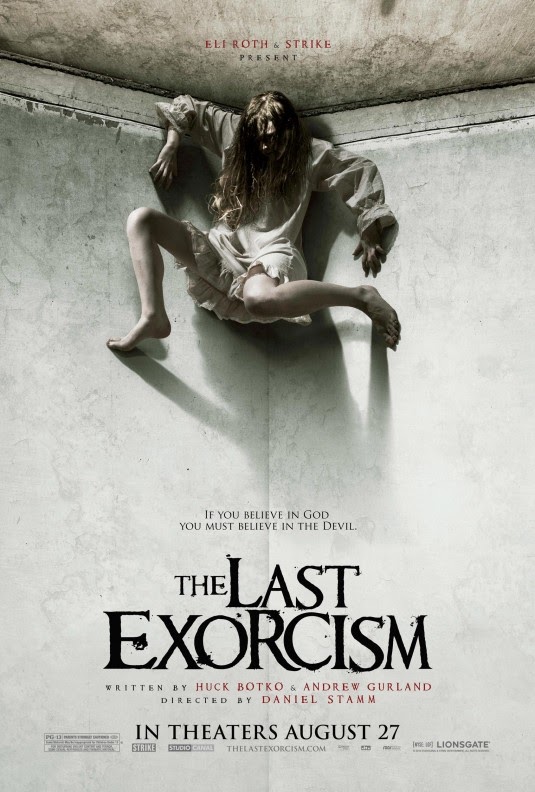
The Last Exorcism (2010)

Dir: DANIEL STAMM
Country: USA

The Blair Witch Project (1999) was a heavy stone thrown into calm waters, and ever since this event the ripples on the surface have steadily increased. In a single stroke The Blair Witch Project validated the internet as a source of promotion, and legitimised the faux documentary form within the terms of genre filmmaking as commercially viable. It did all the things that the far superior The Last Broadcast (1998) did not. Although The Last Broadcast failed to reach a large audience, it remains for me the most creatively successful mock-documentary made. The so called ‘mockumentary’ has almost become a genre in its own right. I say almost because it still relies heavily on the tropes of pre-existing genres, a reliance that totally undermines any documented fake reality the filmmakers are attempting to conjure up. These films should be able to address questions of reality in a more philosophical manner, but it is their attitude to reality which ultimately makes them little more than hollow exercises in style. In these films reality itself becomes a stylistic choice, and when all is said and done, reality is used merely as a device to create more scares. There is of course a far more pragmatic reason for the sudden upsurge in these type of films; the availability and cheapness of technology means they are dirt cheap to produce. But it seems that gone are the days when inspirational filmmakers could turn a low budget into an opportunity too find different ways of producing interesting results.

Friday, 29 April 2011

Monsters (2010)

Dir: GARETH EDWARDS
Country: UK

I can imagine that many a mindless moron rented or purchased this title expecting the usual masturbatory excesses of modern CGI, and the hollow spectacle of alien marauders laying waste to mankind. One can well imagine the disappointment of the retards when Monsters develops into a subtle and nuanced character driven narrative that is far more concerned with humanity than it is showing off its visual effects. The sparing attitude to special effects allows the uncluttered narrative an opportunity to develop in interesting ways and retain an emotional core that might have been lost amid the artificiality of modern filmmaking techniques. Monsters also distinguishes itself in the creative control wielded by newcomer Gareth Edwards. British filmmaker Edwards not only wrote and directed Monsters but also acted as cinematographer, production designer and created many of the visual effects. This was also Edwards’ first feature film and he imbues it with a fearless impetuosity and an impressive awareness of the genre it sits within. It is perhaps a little too early to think of Edwards as an auteur, but this level of creative control is most unusual in genre filmmaking, and signifies to me at least, that the career of Edwards will be worth keeping an eye on. It will be interesting to see if Edwards is able to maintain this when the big budget investment of American producers inevitably comes his way.

Thursday, 7 April 2011

We Are What We Are (2010)

Dir: JORGE MICHEL GRAU
Country: MEXICO

AKA:
Somos lo que hay (Original title)

Mexican writer/director Jorge Michel Grau has crafted a powerful debut feature which seamlessly blends horror and art cinema into a potent social allegory which has the family at its centre. Although Grau downplays the horror elements of his narrative, the decision to use certain generic signifiers offers a potential new direction for an increasingly unadventurous national cinema that seems more preoccupied in genuflecting at the altar of past glories. For much of the films running time this is a family melodrama, but one which becomes increasingly desperate and hysterical. With this increase in tension comes certain plot revelations that propels the frantic family into a series of actions that eventually lead to disunity and downfall. The film opens with the death of the family patriarch in a modern shopping mall. After riding the gleaming escalators the man stares with undisguised hunger at a series of shop mannequins, before throwing up black vomit and expiring on the spotless white floor tiles. Within seconds of his death his corpse has been carted off and his mess mopped up. The swiftness and efficiency of his removal in this middle class consumerist space is easily the most troubling aspect of this opening. We soon discover that not only was this bedraggled chap the head of the family, but also the hunter. For we are in the company of a family of modern day cannibals. His addiction to whores, and the implicated disease ridden nature of their flesh, not only costs him his life, but plunges his family into crisis.

Tuesday, 1 February 2011

Devil (2010)

Dir: JOHN ERICK DOWDLE
Country: USA

The stock of writer/producer/director M. Night Shyamalan couldn’t be much lower after a series of feeble and derisory films that have contrived to make his first two (The Sixth Sense [1999) and Unbreakable [2000]) seem half decent. The reality is that Shyamalan has yet to direct a good film, and a film that has his name attached to it is only fit for the trash collector. That is until the release of Devil, which was based upon a story by Shyamalan, and is refreshingly bereft of his normal posturing and pretence, and has a narrative which isn’t totally reliant on tricks. It is still recognisable as its authors work because of a central gimmick which entraps five total strangers in a malfunctioning elevator. If the claustrophobia, proximity, and fear of this situation isn’t enough, one of the occupants also happens to be the devil. This central proposition is intriguing enough to carry the whole film, and the film is blessed with a director who approaches the material with economy and a briskness of pace. I’m not sure how John Erick Dowdle got this assignment, because his previous film Quarantine (2008) was so appalling that new adjectives had to be invented to describe just how bad it was. But Dowdle emerges as the unlikely hero of Devil because of an efficient and smooth filmmaking approach that mirrors the simplicity of the story. The screenplay by Brian Nelson - the ‘brain’ behind moronic flotsam such as Hard Candy (2005) and 30 Days of Night (2007) offers levity to the restricted confinement of the elevator with two other narrative strands offering a police investigation, and the efforts of various professionals to free the unfortunates who are trapped. But Nelson does make one decision which almost destroys Devil before it has an opportunity to get going.

Related Posts with Thumbnails