Showing posts with label Italian Cinema. Show all posts

Thursday, 17 July 2014

Celluloid Sounds - Street Law (1974)

The 1974 ‘Euro-crime’ film Street Law is one of my personal favourites of the cycle. I took a risk on it when I imported Blue Underground’s DVD release of the film back in 2006. But I’ve always found that particular distributor to be very reliable in terms of quality and interest. The film was my entry point into the violent, exciting, reactionary, and uncompromising world of the Italian ‘Euro-crime’ cycle and for this I owe the film a debt of gratitude. The director of the film was Enzo G. Castellari who was no stranger to the various cycles that constituted popular cinema in Italy in the 1960’s and 1970’s. Castellari’s early westerns were rather drab and predictable affairs, singularly unmemorable, and offered little promise of the films to come. The first hint of Castellari’s capabilities came in the war film Eagles over London (1969). He followed this with the dour and lacklustre giallo Cold Eyes of Fear (1971), which unsurprisingly remained his only entry in this cycle.  For the next few years Castellari concentrated on crime pictures, creating an impressive and consistent body of work which included High Crime (1973), The Big Racket (1976), The Heroin Busters (1977), and Day of the Cobra (1980).

Wednesday, 9 July 2014

Mark the Narc (1975)

Dir: STELVIO MASSI
Country: ITALY

AKA:
Mark il poliziotto
Blood, Sweat and Fear
Mark of the Cop

The big three directors who inhabit the murky, tough, and violent world of the Italian ‘Euro-crime’ cycle are Fernando Di Leo, Umberto Lenzi, and Stelvio Massi. It seems that history has been the kindest to Di Leo, who has selected titles available in high definition and is generally regarded as an important filmmaker in the landscape of popular Italian cinema. Fairing slightly worse is Umberto Lenzi, and this is almost entirely due to his risible cannibal escapades rather than his solid, if unexceptional, entries in the ‘Euro-crime’ and ‘Giallo’ cycles. Due to the vagaries of distribution the filmography of Massi is the least explored of the three, and as a result Massi is not discussed anywhere near as prolifically as the other two men. Although all three filmmakers owe debts of gratitude to the Hollywood films that inspired them, perhaps Massi most of all showed his influences a little too freely. This can be seen most keenly in his 1975 thriller Mark the Narc which is one of the most rigorous pastiches of the first two films to feature Clint Eastwood as San Francisco detective Harry Callaghan. 


Sunday, 20 January 2013

The Ruthless Four (1968)

Dir: GIORGIO CAPITANI
Country: ITALY/WEST GERMANY

AKA:
Chacun Pour Soi
Every Man for Himself
Sam Cooper's Gold
The Goldseekers

It’s always a pleasure to discover a hidden gem, but unfortunately it is an increasingly rare occurrence nowadays. This is especially so in a cycle as dense and derivative as the Euro-Western. But my interest in the Euro-Western was recently piqued again by the purchase of an excellent book called Any Gun Can Play, written by Kevin Grant, and published by FAB Press in 2011. If hidden cinematic gems are rare, then well written books on film are like goldust. The Ruthless Four (one of many titles it was released under) is one such discovery, and the analogy with gold is appropriate, for the film charts the damaging and corrosive effect, this particular precious metal can have on human beings. There are certain themes and concerns that are endemic in the Euro Western, and one theme this cycle returns to time and again is greed. This theme is of course also present in both traditional American westerns, and the revisionist westerns that followed in the wake of A Fistful of Dollars (1964). But the difference lies in the way that this theme is presented. The traditional western always seeks to emphasise the positive aspects of its principal themes, and greed exists as part of a cross-current of themes that ultimately serve a redemptive plot. In many European examples greed is the entire raison d’ĂȘtre of the film, with screenplays often allowing no room for anything else, as they explore its acidic effect.

Monday, 24 September 2012

Calling All Police Cars (1975)

Dir: MARIO CAINO
Country: ITALY

AKA:
...a tutte le auto della polizia
Without Trace

Calling All Police Cars is one of the most notable obscurities to cross my desk in recent months. I say notable because its position within the landscape of popular Italian cinema of the 1970’s is truly undeserved. I have yet to read a negative assessment of this film, but the problem is being able to actually find any critical writing on it at all. The age of DVD has been particularly kind to some films and directors from this era, in some cases richly deserved, in others far from it. Mario Caino appears to be a director that frequently slips through the net, though the few films of his I have seen, easily stand up to many of his contemporaries. Caino is perhaps best known to fans of cult cinema for his 1965 gothic horror picture Nightmare Castle, which featured British actress Barbara Steele in dual roles, beautiful cinematography by Enzo Barboni, and a fitting score by Ennio Morricone. This distinctive contribution to Italian cinema’s gothic horror cycle was not really followed up though, as Caino found a productive niche in the popular and profitable spaghetti western cycle; titles include Ringo; Face of Revenge (1967, featuring Anthony Steffen), Train for Durango (1968) and My Name is Shanghai Joe (1973, featuring Klaus Kinski). Caino further proved his skill at adapting to different genres with Milano Violenta (1976, aka Bloody Payroll) and the Henry Silva starring Weapons of Death (1977), both of which were assured entries in the Euro-Crime cycle. A departure into the vile and sleazy world of Nazisploitation resulted in Caino’s most controversial film Nazi Love Camp 27 (1977), which, despite its subject matter, was still quite effective.

Friday, 14 September 2012

Colt 38 Special Squad (1976)

Dir: MASSIMO DALLAMANO
Country: ITALY

AKA:
Quelli della calibro 38

Thus far on every occasion that a film directed by Massimo Dallamano has crossed my line of sight and made it to the screen, I’ve generally been impressed by the results. I say generally because his 1969 take on Venus in Furs left me cold, unimpressed, and most damagingly of all; bored! But since that fateful afternoon where I lost ninety minutes of my life to that asinine garbage, the films of his I have screened have had me reaching for the superlatives. The giallo double of What Have They Done to Solange? (1971) and What Have They Done to Your Daughters? (1974) were remarkably consistent examinations of not only corrupted innocence, but also how a mask of innocence and youth can conceal all manner of perversions. The former totally outgrew the Edgar Wallace pot-boiler which it took tacit inspiration from, and the latter injected some of the high octane action strategies of the Polizio/Euro-crime cycle into its formulaic gialli narrative. It is this fusion of elements which points forward to Dallamano’s inevitable full blown entry into the Polizio/Euro-crime cycle with the fast paced thriller Colt 38 Special Squad. He seems far more confident amongst the chase sequences, shootouts, fistfights, and vengeful violence of this cycle than the muted atmospherics of the passable The Night Child (1975), the rather dry and forgettable horror flick that preceded it. One of the great tragedies of popular Italian cinema was that Colt 38 Special Squad would be Dallamano’s last picture; certainly on the evidence displayed here Dallamano could have made a number of vital contributions to the cycle, and would no doubt have further enriched a variety of generic soil.

Monday, 23 July 2012

Illustrious Corpses (1976)

Dir: FRANCESCO ROSI
Country: ITALY/FRANCE

AKA:
Cadaveri Eccelenti
The Context

Generally speaking the poliziotesschi/Euro-crime cycle can be divided into four distinct thematic and narrative strands. The first explores the power struggles, relationships, and group dynamics of organised crime mobs, and are best represented by the early formative crime flicks of Fernando Di Leo; most notably Milano Calibro 9 (1972), and The Boss (1973). The second explores the manner in which innocent members of society, frustrated by the inactivity of the police, take the law into their own hands, and seek retribution through violent means; a good example is Street Law (1974), which took as its inspiration Michael Winner’s defining statement on vigilantism Death Wish (1974). The third and most pervasive strand was inspired by the rule breaking rogue cop seen in Dirty Harry (1971), and these films are marked by themes of police brutality, sticky networks of bureaucratic red tape, and detectives frequently breaking the law in order to maintain their own sense of moral equilibrium; almost any Italian crime film of the 1970’s featuring the talents of Maurizio Merli fits this description. These three narrative types are united by high octane energy, stylised shoot outs and fistfights, dangerous chase sequences, and pulse pounding soundtracks.

Monday, 16 July 2012

Cannibal Ferox (1981)

Dir: UMBERTO LENZI
Country: ITALY

AKA:
Make Them Die Slowly

If the Italian cycle of cannibal movies in the 1970’s and early 1980’s is the illegitimate bastard offspring of the Mondo film, then Umberto Lenzi’s Cannibal Ferox is a stillborn foetus; an abortion that was shit out into the world by people who should have known better. The pride with which the promotional material boasted of its banning in thirty one countries (some DVD releases still assert it is banned in 31 countries!) is a key signifier of the feeble minds behind the project. Lenzi was no stranger to the debased faux-exoticism and casual racism of the cycle. He was there right at the start, helping to put in place a canvas of cruelty and sadism. However his first effort The Man from Deep River (aka Deep River Savages, 1972) was an intriguing, and a not altogether unsuccessful remake of A Man Called Horse (1970), and naturally had a far greater investment in themes of ‘going native’, the limitations of modern civilisation, and the rules and doctrines of a primitive and wild culture. In this example cannibalism is associated with villainy and evil, it is an antagonistic and oppositional force; a position which would be completely reversed by Cannibal Holocaust (1980) and Cannibal Ferox. In these two films cannibalism is a reactionary behaviour, a response to external threats. Lenzi’s second cannibal film was Eaten Alive! (1980), despite its hysterical title, it emerges as one of the more placid entries in the sub-genre. The emphasis here is on adventure rather than flesh eating. Although Cannibal Ferox is vile and loathsome it does have a point-of-view, it does (believe it or not!) construct an argument, and (even more unbelievably) follows it through to a cynical and ironic conclusion. For this reason Cannibal Ferox is not the worthless celluloid offal many would have you believe.

Monday, 25 June 2012

Anthropophagus (1980)

Dir: JOE D'AMATO
Country: ITALY

AKA:
Anthropophagus: The Beast
Anthropophagus: The Grim Reaper
Man-Eater
The Grim Reaper
The Savage Island

This excruciatingly dull exercise in cinematic mediocrity achieved an unlikely prominence in the United Kingdom when it found itself a part of the ‘Video Nasty’ hysteria. An uncut video of this film was released in 1980 by VFP in the days before certification, and this grubby item can now fetch very large sums amongst idiots who have too much money and too much time on their hands. It should be remembered that thirty-nine videos were successfully prosecuted by the Director of Public Prosecutions (DPP) and Anthropophagus was one of them, so this is definitely one of the big boys that rubs shoulders with the likes of Cannibal Holocaust (1980), I Spit on Your Grave (1978) and Faces of Death (1978). The vast majority of the titles on this final list of thirty-nine have been released in the UK uncut (some of them on blu-ray!), but Anthropophagus has remained a persistently troubling title for the BBFC. This is almost entirely due to a ridiculous scene towards the end of the film when George Eastman’s cannibalistic psychopath removes a foetus from a heavily pregnant woman and proceeds to eat it. It would seem that the BBFC do not have a healthy appetite for this type of material, even armed with the knowledge that the foetus is merely a skinned rabbit. The upshot of this controversy of course is that when small distributors put films like this forward for certification they take the decision to pre-cut the film and Anthropophagus exists in this form (shorn of two minutes) and is available on DVD under the title The Grim Reaper.

Monday, 18 June 2012

Django (1966)

Dir: SERGIO CORBUCCI
Country: ITALY/SPAIN

Although Sergio Leone’s A Fistful of Dollars (1964) became the pin up poster boy of the spaghetti western cycle, it is arguably Sergio Corbucci’s Django which wielded the greatest influence on European westerns. The central character went on to feature in well over fifty spin offs, the vast majority of which, were unofficial. The success of the film in West Germany led too Italian actor Franco Nero forever being associated with the role, and almost every western he appeared in thereafter was promoted in West Germany as a Django picture. The reason its vast influence remains largely unrecognised, is that unlike Leone’s ‘Dollars’ trilogy, Django was not a commercial success in the United States. The influence of A Fistful of Dollars was not immediate; indeed most of the Euro-westerns released in the wake of Leone’s film were actually quite traditional. It is conceivable that this might have remained the case were it not for Sergio Corbucci who had clearly paid attention to the exaggerated style, cynicism, revisionism, and mythical anti-heroism that formed the basis of Leone’s westerns. Corbucci’s major innovation was to take these elements (minus the exaggerated stylisations) and push them to the extreme. If A Fistful of Dollars was pessimistic then Django had to be nihilistic. If the landscape seen in A Fistful of Dollars was dusty, dry, and sun baked then the landscape in Django had to be wet, muddy, and grey. The influence of A Fistful of Dollars can be felt in Django, yet at the same time Django is everything that A Fistful of Dollars is not.


Friday, 1 June 2012

Your Vice is a Locked Room and Only I Have the Key (1972)

Dir: SERGIO MARTINO
Country: ITALY

AKA:
Excite Me
Eyes of the Black Cat
Gently Before She Dies

Your Vice is a Locked Room and Only I Have the Key (it’s a bit of mouthful, but still an awesome title) was Italian filmmaker Sergio Martino’s fourth attempt to concoct excitement and entertainment within the highly stylised environs of the giallo. His previous three The Strange Vice of Mrs. Wardh (1971), The Case of the Scorpion’s Tail (1971), and All the Colours of the Dark (1972) showed a filmmaker willing to develop and expand upon the conventions he was working in. The Strange Vice of Mrs. Wardh wore its influences a little too noticeably, but was still a confident first effort. The Case of the Scorpion’s Tail offered refinement, and was a solid progression on the previous film, if still somewhat overshadowed by its mimicry of others. The culmination of Martino’s vision came in All the Colours of the Dark; his first giallo to stand firmly on its own two legs, show some innovation, and offer the possibility of a unique brand of gialli with the indelible stamp of Martino’s personality. With this in mind Your Vice…has to be considered something of a retrograde step, and while some may cite the films cross pollination of gothic modes of address within the form of the giallo as evidence of innovation, one only need look to the marvellously baroque The Night Evelyn Came out of the Grave (1971), which appeared a year before Martino’s film, and is far superior on almost every level.

Saturday, 21 April 2012

Planet of the Vampires (1965)

Dir: MARIO BAVA
Country: ITALY/SPAIN

AKA:
Terrore Nello Spazio
Planet of Blood
The Demon Planet
The Haunted Planet
The Planet of Terror

Perhaps more than any other work in Mario Bava’s diverse and fascinating filmography, his 1965 science-fiction/horror effort Planet of the Vampires best illustrates the Italian’s unerring ability to utilise the limited resources at his disposal in a positive fashion. Planet of the Vampires, like the majority of Bava’s pictures, was a threadbare production made on a poverty row budget. It did however have the benefit of Samuel Z. Arkoff and James H. Nicholson as executive producers, and a subsequent guarantee of US distribution through their company AIP. The source material was a short story by Renato Pestriniero entitled One Night of 21 Hours, a story which remains as obscure as the man himself. If anyone knows anything more about Mr. Pestriniero please feel free to leave a comment. This was subsequently adapted for the screen by Mario Bava, Alberto Bevilacqua, Callisto Cosulich, Antonio Roman, and Rafael J. Salvia. A consequence of being in partnership with AIP however was the necessity of an English language version; herein lies one of the great tragedies to afflict Planet of the Vampires. The English version was handled by Danish novelist/screenwriter/director Ib Melchior (The Angry Red Planet [1959], The Time Travellers [1964], Robinson Crusoe on Mars [1964]) and Louis M. Heyward (writer of such masterpieces as Pajama Party [1964], The Ghost in the Invisible Bikini [1966] and Dr. Goldfoot and the ‘S’ Bomb [1966]). My assessment of their contribution to Planet of the Vampires is thus; watch the original Italian language version!

Thursday, 12 April 2012

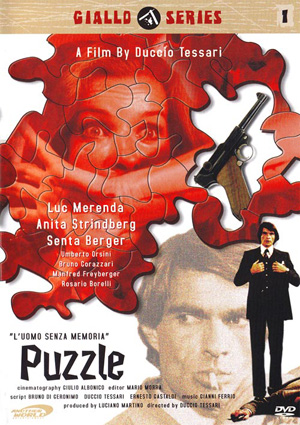
Puzzle (1974)

Dir: DUCCIO TESSARI
Country: ITALY

AKA:
L'uoma Senza Memoria
Man Without a Memory

Having carved himself a niche in the ripped torso’s, tests of strength, and myth and fantasy of the peplum, and then confidently leaped into the saddle for the dusty heat and cynical violence of the spaghetti western, it was inevitable that director Duccio Tessari would eventually find himself staring into a bottle of J&B Whiskey and making himself at home amid the chunky turtle neck sweaters, blazers, and camp penthouse apartments of the giallo. But like Fernando Di Leo, Enzo G. Castellari, and Tonino Valerii, directors more commonly associated with other popular cycles, Dessari’s journey into the jet-set cosmopolitanism of the giallo was brief, but in one case at least, very memorable. This memorable addition to the fabric of the cycle was in actual fact his first foray, the beautiful and evocatively titled The Bloodstained Butterfly (1971). Tessari’s means of stylistic expression was significantly more restrained in this example, and the broad violent punctuation marks represented by the set piece are barely in evidence. Instead Tessari very wisely adopted a more simplified filmmaking approach which serves the tightly plotted narrative, instead of overwhelming it. He was aided in his cause by a fine score from Gianni Ferrio, expert cinematography by Carlo Carlini, and a solid lead performance by Helmut Berger.

Thursday, 29 March 2012

Rome: Armed to the Teeth (1976)

Dir: UMBERTO LENZI
Country: ITALY

AKA:
Roma a mano armata
Assault with a Deadly Weapon
Brutal Justice
The Tough Ones

In recent months I’ve had the opportunity to scrutinise in more detail the long and varied career of Italian director Umberto Lenzi. My relationship with Lenzi’s films have been fraught and negative at the best of times, but I have to confess to finding myself mellowing towards his work with each passing obscurity that crosses my desk. After all Lenzi has directed over sixty films and only one of them was called Cannibal Ferox (1981). The prevailing consensus has it that Lenzi’s career can be divided into two distinct camps. In the first are his many contributions to the giallo and poliziotesschi cycles, which are fondly recalled, and generally considered half decent. In the second camp is everything else! From what I have seen so far that seems to be a fair assessment. But the overriding problem I have with Lenzi’s films still remains; namely that Lenzi himself is never the best thing about his films. His 1976 poliziotesschi flick Rome: Armed to the Teeth is a very good working example of this. Without a doubt the most distinctive aspect of this production is its cast. The film is led by Maurizio Merli (much maligned in some quarters, but I’ve always found him to be an appealing actor), who by this point was a veteran of the cycle, and could do the tough guy cop routine in his sleep. The supporting cast includes excellent turns from Tomas Milian, Arthur Kennedy, Ivan Rassimov, and Giampiero Albertini and these performances serve to offset Merli’s lack of dimension. The films second most distinctive feature is the superb musical contribution of Franco Micalizzi, and then maybe…and it’s a big maybe, we might put the direction of Lenzi third.

Wednesday, 21 March 2012

The New York Ripper (1982)

Dir: LUCIO FULCI
Country: ITALY

A viewing of Lucio Fulci’s scandalous The New York Ripper has almost become something of a rites of passage for horror fans looking too experience the more extreme and unpleasant end of the spectrum. It wields a strange repulsive fascination not dissimilar to controversial ‘Video Nasties’ such as Cannibal Holocaust (1980) and I Spit on Your Grave (1978); to see them, and to own them in uncut prints, is seen as something of a badge of honour in some quarters. Fortunately such juvenilia are not to be found on these pages, and my encounter with this repugnant artefact came as a result of a piece of research into British film censorship. It’s not a film I would watch by choice, but then who would? Although it is often situated within the giallo cycle I find this position to be nominal at best. By 1982 the giallo was no longer a major force of influence within the horror genre, if anything gialli were absorbing influences from elsewhere; most notably from the American slasher film. A reversal of positions as it was, and one which would have a damaging effect on the giallo as films increasingly took on the appearance of cut rate slasher flicks. The New York Ripper is a very good example of this trend. Its prevailing influence was William Lustig’s squalid Maniac (1980) rather than The Bird with the Crystal Plumage (1970) or Deep Red (1975).

Saturday, 3 March 2012

Keoma (1976)

Dir: ENZO G. CASTELLARI
Country: ITALY

AKA:
Desperado
Django Rides Again
Keoma: The Avenger
The Violent Breed

By the late 1970’s the landscape of the Euro-Western was limp and lifeless, the generic terrain parched and infertile. The occasional production little more than tumbleweed in a dusty and decaying town. The Spaghetti Western Database lists a paltry eight productions for 1976 and it would be fair to say that Enzo G. Castellari’s entry Keoma stands head and shoulders above the rest. Some argue that Keoma was not only the last important spaghetti western, but also one of the best ever made. Whilst I find the former possesses a nugget of truth, the latter is a lot harder to substantiate. However one fact that is undeniable is that out of the eight westerns that Castellari directed, Keoma is probably the most accomplished. I’ve argued elsewhere that although Castellari worked in a multitude of genres, his films, structurally at least, adhered very closely to the conventions of the western. So it’s something of a surprise to discover that until Keoma, he hadn’t directed a truly important or genre defining example. One of the major ingredients lacking in previous Castellari westerns is the sort of barnstorming and forceful performance that Franco Nero puts in as the beleaguered half-breed Keoma. With his wild and unkempt beard, penetrating blue eyes and long hair (actually a wig) Nero makes an indelible impression the likes of which audiences hadn’t enjoyed since Django (1966). Nero has his critics, but you won’t hear any negativity from me. Nero is at his charismatic best here and so dominates proceedings that the films director becomes totally overshadowed.

Sunday, 26 February 2012

What Have You Done To Solange? (1972)

Dir: MASSIMO DALLAMANO
Country: ITALY/WEST GERMANY

AKA:
Cosse avete fatto a Solange?
Who's Next?
Solange
Terror in the Woods
The School that Couldn't Scream
The Secret of the Green Pins

In January 2011 I dedicated an entire month of The Celluloid Highway to the Italian giallo. Of the films I reviewed that month I was most impressed by Massimo Dallamano’s 1974 entry What Have They Done to Your Daughters? I particularly enjoyed the confident manner in which the narrative strategies of the giallo were fastened to the high octane thrills and spills one would commonly associate with the poliziotesschi. From 1946 to 1966 Dallamano carved out a career as a cinematographer, the culmination of which was his work on A Fistful of Dollars (1964) and For a Few Dollars More (1965). But as a director we are only left with the merest of legacies. He only directed twelve feature films before his untimely death in a car accident in late 1976. On the strength of Venus in Furs (1969) and the aforementioned What Have They Done to Your Daughters? I was determined to explore as many of his dozen films as I could. Unfortunately I was waylaid on this quest and Dallamano was filed away for future reference. A year later I finally got the opportunity to screen his first giallo What Have You Done to Solange? and was immediately surprised (and not to mention a little weary) of the unanimous praise the film has received in critical circles. Only a select band of gialli have reviewed as well as Solange. I expected the film to struggle to live up to its reputation, but I’m pleased to report this is one film that is deserving of its current status amid the highest echelon of the cycle.

Thursday, 2 February 2012

Conquest (1983)

Dir: LUCIO FULCI
Country: ITALY/SPAIN/MEXICO

It is not unfair to say that Fabrizio De Angelis and Ugo Tucci’s decision to hire Lucio Fulci as director for their horror production Zombi 2 (1979) saved his career. The pair embarked on a wave of excessively gory and increasingly incoherent horror pictures, inflicting such delights as The Beyond (1981), The House by the Cemetery (1981), The New York Ripper (1982), and Manhattan Baby (1982) on an unsuspecting public. These were all critical titles in Fulci’s cult resurgence in the 1990’s and beyond, and for many, Fulci’s work under the auspices of De Angelis represents his most impressive. Unfortunately some time between the release of Manhattan Baby and pre-production on Fulci’s next picture Conquest the two parted company. Little did Fulci know that whoring himself out to the highest bidder - in this case Giovanni Di Clemente - would have such a devastating effect on the quality of his films. I’m not arguing that the De Angelis produced films were masterpieces, only a complete asshole could make a case for Manhattan Baby. But Conquest is so nonsensical and drab, and so utterly bereft of intelligence and charm, that one cannot help but conclude that Fulci’s current standing amongst horror aficionados is as much down to De Angelis as it is Fulci.

Wednesday, 1 February 2012

Knife of Ice (1972)

Dir: UMBERTO LENZI
Country: ITALY/SPAIN

AKA:
Il coltello di ghiaccio
Silent Horror

I should start this review by saying I’m not a big admirer of the films of Umberto Lenzi. I’m well aware of the high esteem he is held in by enthusiasts of cult Italian cinema, but to date I’ve only seen marginal evidence to suggest that Lenzi is little more than an incompetent and talentless hack. I say marginal because I am rather fond of his unconventional and surprising giallo Spasmo (1974), and he did make some striking contributions to the poliziotesschi cycle - most notably Almost Human (1974), Assault with a Deadly Weapon (aka Brutal Justice, 1976), and Violent Naples (aka Death Dealers, 1976). But what these films highlight is the strength of the casting, rather than Lenzi’s direction. I’m often very charitable to those filmmakers who were overshadowed/overlooked in favour of the Bava’s, Argento’s and more recently Fulci’s of the world, but I find Lenzi’s position to be entirely justified. If his career was overshadowed by others, then so too is the mans filmography. In this case by the odious excrement entitled Cannibal Ferox (1981). His earlier departure into the ‘Green Inferno’ The Man from Deep River (1972) was far superior, but Lenzi’s attempt to out grotesque Cannibal Holocaust (1980) casts a long and repulsive shadow over his career.

Saturday, 14 January 2012

The Strange Vice of Mrs. Wardh (1971)

Dir: SERGIO MARTINO
Country: ITALY

AKA:
Lo strano vizio della Signora Wardh
Next!
Blade of the Ripper
The Next Victim!

Like his contemporaries Umberto Lenzi, Enzo G. Castellari, and Lucio Fulci, Sergio Martino was a director who possessed a highly developed degree of generic utility. This ensured that Martino and the others were constantly in demand in the 1970’s and 1980’s, but the price they all had to pay for this was critical marginalisation. However were it not for the commercial success of popular cycles such as the giallo, the spaghetti western, and the poliziotesschi films, the preening ‘art’ cinema of dullards such as Fellini, Antonioni, and Bertolucci, would undoubtedly have struggled to gain the domestic support they required. Sergio Martino’s renaissance has taken a little longer to come about, but like many of his ilk, the era of DVD has been critical in constructing an appreciation of a diverse and intriguing filmography. No longer do scribes have the excuse of films being unavailable. Whilst it is remiss not to place Dario Argento’s early films within the expectations of the cycle they operated within (a major weakness of Maitland McDonagh’s Broken Mirrors/Broken Mind’s was a failure to do this), it would also be equally remiss not to assess the important contribution to the cycle made by Martino and his producer brother Luciano. Although Martino was inspired by the success (and the style) of Argento’s debut picture The Bird with the Crystal Plumage (1970), his own gialli offerings have a peculiarity and an attitude which help them to stand apart in a very overcrowded generic landscape.

Monday, 9 January 2012

Lobby Card Collection - For a Few Dollars More (1965)

Following quickly on the heels of the lobby cards for A Fistful of Dollars (1964) I present a selection of stills for Sergio Leone's 1965 sequel For a Few Dollars More. This is my personal favourite of Leone's westerns, and the following three sets of lobby cards were used to promote the film in British, French and West German cinemas.


Related Posts with Thumbnails