Monday, 8 August 2011

Street Law (1974)

Dir: ENZO G. CASTELLARI
Country: ITALY

AKA:
Il cittadino si ribella
Vigilante II
The Citizen Rebels
The Anonymous Avenger

Like most filmmakers working in the environment of popular Italian cinema between the mid 1960’s to the mid 1980’s Enzo G. Castellari found switching from one genre to another an easy task. It was made easy to him because the only difference between his westerns, crime thrillers, war movies, and post-apocalyptic science-fiction adventures was iconography and setting. At their heart almost all of Castellari’s films are westerns. It was rare for him to step out of the terrain of the action movie, and the narrative structures associated with westerns. When he did the results were almost always unspectacular, as his only giallo production Cold Eyes of Fear (1971) proves. Street Law was Castellari’s second bite at the poliziotteschi cherry after High Crime (1973) which also featured Franco Nero in the lead and is often overlooked due to its unavailability. It is in fact marginally superior to Street Law. But where Street Law does succeed is in its high degree of polish and the precision of its stunt work and action set pieces. High Crime can be seen as something of a dress rehearsal One that has descended into the murky abyss of a distribution limbo. Street Law’s prominence and longer lasting appeal is almost certainly due to is closeness to Death Wish (1974) and the torn from the tabloid hysteria that informs the opening montage.

Monday, 1 August 2011

Drunken Angel (1948)

Dir: AKIRA KUROSAWA
Country: JAPAN

AKA
Yoidore tenshi

This beautifully constructed and expertly composed noir gangster film was Akira Kurosawa’s eighth production as director. Prior to Drunken Angel is it fair to say that Kurosawa’s career had been one of interesting, but ultimately forgettable films. Kurosawa himself believed that Drunken Angel represented a major creative breakthrough, and although there is evidence of brilliance in his debut picture Sanshiro Sugata (1943), and moments of sublime quality in No Regrets for Our Youth (1946) and Those Who Make Tomorrow (1946) I am inclined to agree that Drunken Angel is light years ahead of those earlier efforts. Here Kurosawa utilises the generic tropes of imported genres such as noir and the American gangster film and fuses it with a political symbolism that makes clear statements about post-war Japan. The inbuilt pessimism and gloom of noir is a suitable form within which too address questions of national identity and social fragmentation, and the archetypes of the gangster film are used as stand ins for the country at large and become walking metaphors. The film sits uneasily in a discussion of genre. The screenplay which Kurosawa wrote in collaboration with Keinosuke Uekusa is patient in its replication of westernised conventions, but its symbolic and allegorical ambitions and mode of address takes it far closer to art cinema.

Sunday, 24 July 2011

George A. Romero Poster Gallery

NIGHT OF THE LIVING DEAD (1968) #1 - US poster


NIGHT OF THE LIVING DEAD #2 - Italian Poster


NIGHT OF THE LIVING DEAD #3 - West German poster

Monday, 18 July 2011

Extreme Prejudice (1987)

Dir: WALTER HILL
Country: USA

Extreme Prejudice is a criminally underrated and underappreciated film that has improved considerably with time. It was pretty much lost in the macho action movie shuffle in the late 1980’s, seemingly unable to compete with the empty headed adventures of Schwarzenegger, Segal, Stallone et al. One immediately notices its difference by the decision to cast Nick Nolte as the stiff and stoic Texas Ranger Jack Benteen. Nolte is a hard man here, dangerous and ruthlessly violent, he prefers direct physical confrontation over discussion. When one considers that his most recent roles included Down and Out in Beverly Hills (1986), Grace Quigley (1985) and Teachers (1984) one can see that Nolte was very much being cast against type. To say he does an excellent job is something of an understatement. If Extreme Prejudice possesses one thing that separates it from the other action films being made at the time, it is in the superbly convincing performances. The cast also includes Powers Boothe, Rip Torn, Michael Ironside, Maria Conchito Alonso, and Clancy Brown. A beautiful ensemble of solid character actors who are clearly deeply committed to the material. If the cast isn’t enough to whet your appetite the film was directed by Walter Hill, with a screenplay co-written by John Milius. This is macho action movie heaven, and I for one enjoyed every minute.

Sunday, 17 July 2011

Season of the Witch (2011)

Dir: DOMINC SENA
Country: USA

Despite having shown genuine acting ability, and a genuine flair for quirky and peculiar characters, actor Nicolas Cage continues to make atrocious career choices. He recently crafted a wonderful performance as the corrupt New Orleans detective Terence McDonagh in Werner Herzog’s Bad Lieutenant: Port of Call New Orleans (2009). It came as a surprise to most because it reminded audiences that Cage did once possess something special. But films such as Raising Arizona (1987), Wild at Heart (1990) and Leaving Las Vegas (1995) are consigned to history. Only of use to Cage fans and film scholars. The latter always willing to drift into the mists of time for something interesting. For a certain generation Nicolas Cage is represented by films like National Treasure (2004), Next (2007) and The Sorcerer’s Apprentice (2010). He is a man that will seemingly agree to appear in anything. This tends to be something actors do when their star has burned out. Cage can certainly afford to be selective, and is obviously cine-literate enough to know that one doesn’t pass up the chance to work with Werner Herzog. This only makes his decision to appear in something like Season of the Witch all the more perplexing. It is made worse by the fact that Cage is hopelessly miscast. I can’t think of a more inappropriate person to play a 14th century knight rallying against the hypocrisies of the Church.

Friday, 15 July 2011

A Snake of June (2002)

Dir: SHINYA TSUKAMOTO
Country: JAPAN

AKA:
Rokugatsu no hebi

Cult Japanese filmmaker Shinya Tsukamoto has time and again proven himself to be the perfect embodiment of what is traditionally understood as an auteur. From the moment he exploded in a shower of twisted metal onto the international scene with his dystopian tale of bodily transformation Tetsuo (1989), he has written, directed, produced, and designed a raft of uniquely distinctive and unusual feature films. In the years since the hyper-stylised avant-garde formalism of Tetsuo, Tsukamoto’s visual experimentalism has mellowed somewhat. But films such as Hiruko the Goblin (1991), Tokyo Fist (1995), Bullet Ballet (1998) and Vital (2004) continue to document his fascination with the human body.  Whether it be in states of decay or in revolt. The revolution of the human body in the face of a decaying urbanisation is a persistent theme of his work. In his films technology and capitalism are rendered banal and are often the initial cause for an evolution of the flesh. Tsukamoto’s vision is at times a unique one, but it is couched within stylistic and thematic terms which evoke the industrialised dreamscapes of David Lynch, and the grotesque body horror of David Cronenberg. His own influence can be felt on filmmakers such as Darren Aronofsky, Takashi Miike and Jan Kounen. Tsukamoto is also fiercely independent and through his own production company Kaijyu Theatre commands complete autonomy and the freedom too express his innermost fantasies.

Wednesday, 13 July 2011

I Saw the Devil (2010)

Dir: JEE-WOON KIM
Country: SOUTH KOREA

AKA:
Akmareul boatda

South Korean filmmaker Jee-woon Kim continues to enjoy a remarkable level of distribution in the West. His latest film I Saw the Devil was paraded around the festival circuit, before receiving relatively wide distribution in the both the US and the UK. Kim first emerged as a name of note with his debut film The Quiet Family (1998) a comedy/horror film which was loosely remade in typically excessive fashion by Takashi Miike under the moniker The Happiness of the Katakuris (2002). Although interesting, his debut film was left in the dust with the release of A Tale of Two Sisters (2003), a stylish psychological horror film clearly inspired by the popularity of J-horror. This excellent film was remade in America as The Uninvited (2009). The result was a predictably desultory and pathetic re-imagining bled dry of all the aspects that made the original so engaging. Kim confirmed his generic utility with A Bittersweet Life (2005) and The Good, The Bad and The Weird (2008). The former a wonderfully energetic, but incredibly violent gangster movie, and the latter a sprawling western adventure inspired by Sergio Leone’s spaghetti westerns. All of these films have received above average distribution for South Korean films, which is a testament to Kim’s ability to craft generically satisfying material that still manages to push the boundaries of the form. In comparison to his previous films, I Saw the Devil is significantly less interesting. It is not a failure, but it is perhaps Kim’s first stumble, in a career that has thus far been very impressive.

Sunday, 10 July 2011

Evil Dead Trap (1988)

Dir: TOSHIHARU IKEDA
Country: JAPAN

AKA:
Shiryô no wana
Tokyo Snuff

Evil Dead Trap is an absorbing oddity that takes it inspiration from a myriad of western sources. Unusually for a Japanese horror film it pays little heed to its own indigenous traditions and history, preferring to take its cue from the expectations of westernised genres. The screenplay by Takashi Ishii could have conceivably been set anywhere and it gives the film a strange lack of cultural specificity which only confirms the artifice of the whole proposition. Ishii went on to much more interesting things as a writer and director. Films such as the Takeshi Kitano starring Gonin (1995) and the unusual arty rape/revenge thriller Freeze Me (2000). The director Toshiharu Ikeda remains something of an obscurity in the west. Evil Dead Trap is the only film of his that had reasonable trans-national distribution. It is incredibly easy to see why it achieved this. The title itself is a reference to Sam Raimi’s irreverent gore soaked debut The Evil Dead (1981), and the film abounds with the echoes of other filmmakers and films. Perhaps the most notable influence here is the hyper-stylised baroque fantasies of Dario Argento. This inter-textual plundering includes a scene in which maggots fall from a ceiling onto an unsuspecting woman’s head lifted from Suspiria (1977), the use of a colour scheme that evokes both Suspiria and its sequel Inferno (1980), and the repetition of a musical theme courtesy of composer Tomohiko Kira. Unfortunately shoddy prints and patchwork distribution have lessened the effect of Ikeda’s carefully constructed pallette. But the film still emerges as highly inventive and incredibly gory. Qualities that have helped it to become something of a cult film.

Wednesday, 6 July 2011

I Spit on Your Grave (2010)

Dir: STEVEN R. MONROE
Country: USA

In principal I do not object to the idea of remaking films. Genres are after all founded upon filmmaking elements that are entirely familiar to the audience. Anyone with a love of genre cinema, should by the very definition of a genre, have a very high tolerance for the idea of remakes. The trick of course is to present those familiar elements in a manner which seems fresh and new, that so many genre films fail to do this, and in effect become remakes by any other name seems to be overlooked in favour of outright hostility toward the slew of horror remakes that are helping to keep the genre (commercially at least) alive. American cinema is a cinema of remakes, and if you think it is bad now, spare a thought for the silent era, a time in which the vogue for remaking films was at its height. No, the problem for me is pointless remakes. It is not enough simply to remake a film for commercial reasons, one has to provide something that the original doesn’t. The easiest way might be to take a film and adapt its principal themes to a socio/political concern of relevance. The remake of Dawn of the Dead (2004) manages to achieve this, and it surprises me not, that it is largely considered one of the better remakes. The first thing you need then is a film with the plot potential to do this. The original I Spit on Your Grave (1978) is a witless and moronic film, but this could be forgiven if there was some aspect to it that might be relevant to contemporary society. Instead the remake opts to simply regurgitate the same themes and concerns as the original did in 1978. The result is a film that is utterly and completely pointless.

Monday, 4 July 2011

The Man from Laramie (1955)

Dir: ANTHONY MANN
Country: USA

Between 1950 and 1955 filmmaker Anthony Mann made five westerns in collaboration with actor James Stewart. From a structural point of view they adhered quite closely to the traditional western. There was nothing exceptional about them in terms of their narratives and their use of iconography. But the interest in rich characterisation, psychological states, motivation, and back story was very rare for the genre. The Mann/Stewart collaborations are distinctive and cerebral, with every element of the plot in strict synthesis with the story. They are dark affairs with an abiding interest in the hearts of men and women. The Mann/Stewart westerns are less inclined toward the mythological aspects of the traditional western, but at the same time they do not quite embrace what would later be termed revisionist. In these films the hero is not interchangeable with the villains, but the villains are imbued with complex motivations that makes the task of the hero that much more problematic. The Man from Laramie was the final collaboration between the two, and although it doesn’t quite reach the heights of Winchester ‘73 (1950) or Bend of the River (1952), it is still a solid and fitting climax to a generic relationship as equally important as Ford/Wayne.

Sunday, 26 June 2011

Ride the High Country (1962)

Dir: SAM PECKINPAH
Country: USA

AKA:
Guns in the Afternoon
Sacramento

There is an internal paradox to the delightful western Ride the High Country that makes it an intriguing and important proposition. For the actors Randolph Scott and Joel McCrea it was the concluding statement on careers honed in the dust and gunfire of the traditional western. For young filmmaker Sam Peckinpah it was a second attempt at directing a feature film after the forgettable and obscure The Deadly Companions (1961). Within Ride the High Country’s core is both a lamentation for the end of a traditional mode of generic address, and excitement for the new horizons opened by generic revisionism. Here Peckinpah shows his love for the traditional western, but it is a love tempered by an impatient need to move on and push the boundaries of the form. For some the nihilistic bloodbath that concluded The Wild Bunch (1969) may have come as a surprise, but Peckinpah was already making smoke signals in that direction with this film. Up to this point Peckinpah was chiefly known as a writer for television. He had contributed scripts and some direction for episodes of Gun Law (1955-8), Broken Arrow (1957-8), Zane Grey Theatre (1958-9) and The Rifleman (1958-63). His main contribution to western lore however was the creation of The Westerner (1960). This series only lasted for 13 episodes but was vital in securing interest from the major Hollywood studios. Peckinpah’s knowledge of generic typography was cultivated in the restrictive milieu of television, but the expansive possibillities of film allowed him to paint a much larger and thematically rich canvas with his second film.

Friday, 17 June 2011

My Darling Clementine (1946)

Dir: JOHN FORD
Country: USA

The gunfight at the OK Corral and the events surrounding it have become one of the most enduring of Hollywood myths. The traditional Hollywood western is particularly suited to the propagation of myths and legends, the efficiency of the genre lies in its attitude too its own mythology and symbolism, so recognisably iconographic, it is no surprise that film theorists most often turn to the western when discussing genre. It now seems an entirely logical step for the filmmaker most associated with the western to tackle the story of Wyatt Earp. Although John Ford went on to make a number of revisionist westerns in his later career - most notably Sergeant Rutledge (1960) and Cheyenne Autumn (1964), his treatment of the Earp legend is very different to what we might expect. The screenplay by Samuel G. Engel, Winston Miller and Sam Hellman was based on the book Wyatt Earp: Frontier Marshal by Stuart N. Lake. A book which was allegedly written with the collaboration of Earp himself. So we might expect some historical verisimilitude, but the screenplay takes a number of liberties with the real events as Ford indulges in the themes for which he has become well known. In dramatic terms this is a peculiar film. The film does not build to the predictable showdown. It meanders along and concerns itself with very small and intimate details. The gunfight itself is farcically downplayed, and totally lacks any sense of tension or catharsis.

Sunday, 12 June 2011

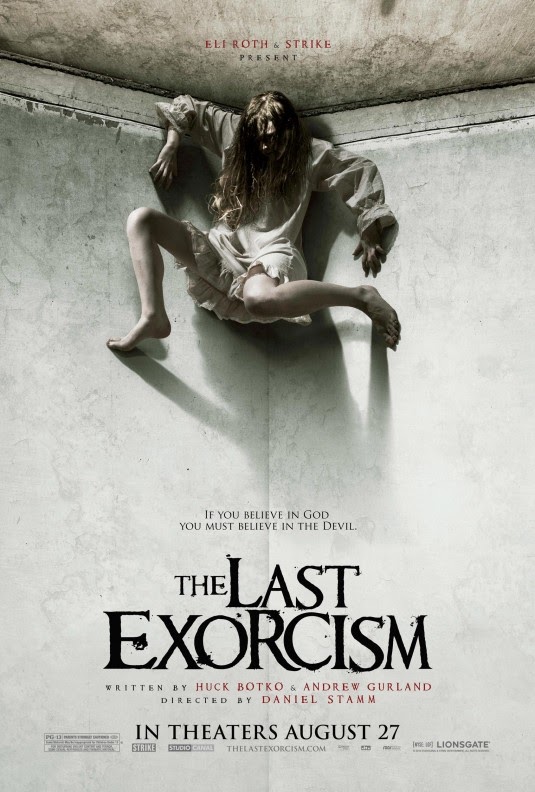
The Last Exorcism (2010)

Dir: DANIEL STAMM
Country: USA

The Blair Witch Project (1999) was a heavy stone thrown into calm waters, and ever since this event the ripples on the surface have steadily increased. In a single stroke The Blair Witch Project validated the internet as a source of promotion, and legitimised the faux documentary form within the terms of genre filmmaking as commercially viable. It did all the things that the far superior The Last Broadcast (1998) did not. Although The Last Broadcast failed to reach a large audience, it remains for me the most creatively successful mock-documentary made. The so called ‘mockumentary’ has almost become a genre in its own right. I say almost because it still relies heavily on the tropes of pre-existing genres, a reliance that totally undermines any documented fake reality the filmmakers are attempting to conjure up. These films should be able to address questions of reality in a more philosophical manner, but it is their attitude to reality which ultimately makes them little more than hollow exercises in style. In these films reality itself becomes a stylistic choice, and when all is said and done, reality is used merely as a device to create more scares. There is of course a far more pragmatic reason for the sudden upsurge in these type of films; the availability and cheapness of technology means they are dirt cheap to produce. But it seems that gone are the days when inspirational filmmakers could turn a low budget into an opportunity too find different ways of producing interesting results.

Monday, 30 May 2011

1950's Sci-Fi Poster Gallery - Part 3

ATTACK OF THE 50 FT WOMAN (Nathan Juran, USA, 1958)


THE BLOB (Irvin S. Yeaworth Jr, USA, 1958)


THE BRAIN EATERS (Bruno VeSota, USA, 1958)

Sunday, 29 May 2011

1950's Sci-Fi Poster Gallery - Part 2

THE BEAST WITH 1,000,000 EYES (David Kramarsky, USA, 1955)


CONQUEST OF SPACE (Byron Haskin, USA, 1955)


CREATURE WITH THE ATOM BRAIN (Edward L. Cahn, USA, 1955)

Saturday, 28 May 2011

1950's Sci-Fi Poster Gallery - Part 1

DESTINATION MOON (Irving Picher, USA, 1950)


ROCKETSHIP X-M (Kurt Neumann, USA, 1950)


THE DAY THE EARTH STOOD STILL (Robert Wise, USA, 1951)

Wednesday, 25 May 2011

The Thing from Another World (1951)

Dir: CHRISTIAN NYBY
Country: USA

AKA:
The Thing

Howard Hawks’ production The Thing from Another World is a towering heavyweight within the landscape of 1950’s science-fiction. Its status as such is in fact highly contestable however because this was the first notable occasion that the tropes of the horror genre were melded seamlessly with that of science-fiction. Like the alien creature that terrorises the isolated Arctic outpost this is a product of hybridity, an example of generic interbreeding that evolved a new form. For this to succeed one requires generic expertise, and none were more savvy at delivering assured genre pieces than producer/director Howard Hawks. The notion of an alien invader intent on the destruction of the human race is now riddled with cliché, but in 1951 this was a narrative innovation for cinematic sci-fi/horror. Hundreds of invasion narratives ebbed and flowed from this one important example, their attitude and politics may have differed, but the template remained unshakeable. The source material came from acclaimed sci-fi writer John W. Campbell Jr. whose short story Who Goes There? first appeared in the August 1938 edition of Astounding Stories. It might be a surprise to some how little Charles Lederer’s screenplay resembles the story, preferring as it does to just adopt the basic premise. For a more rigorous and authentic adaptation one should look no further than John Carpenter’s 1982 remake.

Saturday, 21 May 2011

Day the World Ended (1955)

Dir: ROGER CORMAN
Country: USA

Day the World Ended was Roger Corman’s third official film as a director and his first major foray into the realm of science-fiction. Corman has quite rightly become a cult hero, the messiah of low budget guerrilla filmmaking. But I’m under no illusion that his greatest contribution to cinema came as a producer. There is an easy temptation to be overly generous towards Corman’s 1950’s productions because of the esteem that enthusiasts of genre cinema hold him in. This is often the same attitude taken toward AIP, the production company to which Corman had an intimate relationship. Whereas most directors would be pilloried for amateurishness, Corman’s brand of amateur filmmaking is celebrated. But in the case of Day the World Ended the incompetence of the novice filmmaker is not alleviated by an intelligent screenplay, nor is it saved by an enthusiastic tone - the film is actually incredibly ponderous and suffers from a solemnity that becomes quite irritating at times. I understand that the end of the world is a serious matter, but Lou Rusoff’s screenplay makes no effort to lighten a leaden tone. One would imagine that working within such a sombre and ominous framework the film would be afforded the philosophical and metaphysical insights of serious drama. Instead it opts for the sensational and ultimately comes across as a stupid and empty rip off of Arch Oboler’s far superior Five (1951).

Related Posts with Thumbnails