Sunday, 16 June 2013
Saturday, 15 June 2013
Tuesday, 21 May 2013
Monday, 20 May 2013
Famous Monsters - The Film Art of Basil Gogos
Here at The
Celluloid Highway I do my level best to celebrate some of the finer promotional
materials used in the selling of films I consider interesting. My abiding
interest is not in unimaginatively photo-shopped or blandly airbrushed posters,
but in posters that employ the skills of artists. Naturally this bias is
weighed heavily towards materials produced from the 1950's to the late 1980's,
the period afterward has become an arid creative wasteland, only occasionally
lessened by an all too rare moment of inspired film artwork. The various
journals and magazines published from the 1950's to the late 1980's are an
important part of the promotional machine. Although often the work of dedicated
fans and enthusiasts, these works feed into the images we come to associate
with certain movies and certain genres. One of the key artists working in this
field during the period under discussion was the Egyptian born Greek Basil
Gogos. His wonderful efforts adorned the covers of numerous editions of Famous Monsters of Filmland, Creepy, Eerie, Spaceman, and Wildest Westerns, and many film posters from the period. I don't
own a single copy of any of these magazines; I've never really been much of a
magazine of fanzine purchaser. But my appreciation and admiration of the
artistic efforts involved in their production will never diminish. So without
further ado I invite you on a slightly different journey than normal...into the
monstrous art of Basil Gogos!
Sunday, 7 April 2013
Guest Review - Dracula (1958) - The 2012 Restoration
Country: UK
AKA:
Horror of Dracula
A long time ago I watched a horror movie on
television. I had seen a few horrors before and was beginning to develop a
preference for the genre. There seemed to be one on every Friday night and
occasionally if you were really lucky a double bill. It wasn’t long before one
such Friday Fight Feature on Night Time TV was Hammer’s production of Dracula starring Peter Cushing as a
dashing, determined, younger Van Helsing and Christopher Lee as a full-blooded
and sexually charged Count Dracula. It was directed by Terence Fisher who is
now rightly regarded as an auteur. The only detraction to this stunning
production it seems has been the passage of time. The colour fading, and dulling
of light which can often hide the detail in a film recorded originally with an
emphasis on set design and colour photography. As well as a deterioration of
the sound quality through regular cinema screenings and copies of copies made
for distribution around the world. General ageing and wear and tear have all
played a part in lessening the impact of a once vibrant and visceral rendering.
Wednesday, 20 March 2013
Wake in Fright (1971)
Dir: TED KOTCHEFF
Country: AUSTRALIA/USA
AKA:
Outback
It is becoming all too
rare nowadays to see a film that leaves a genuinely indelible impression. A
combination of my own academic education (which pretty much destroyed the magic
of the movies) and a gradual desensitisation towards challenging and provocative
material means that most films cross my line of sight with barely a blip on my
internal Richter scale. But occasionally one can still find that precious
diamond buried beneath the tonnes of coal. It doesn’t surprise me in the least
that when such a discovery is made the film is quite often a product of the
1970’s. One such recent discovery was an Australian film called Wake in Fright, a nightmarish narrative
that left me bewildered and devastated in equal measure. That we can now view Wake in Fright in a pristine high
definition transfer is a tremendous privilege. For decades the only print of
the film in existence was considered totally insufficient for either VHS or DVD
release. But thanks to the dogged efforts of the films editor Anthony Buckley,
the negatives were located, and one of the most important restoration processes
in modern film history was able to take place.
Tuesday, 19 March 2013
Guest Review - Dracula A.D. 1972 (1972)
Dir: ALAN GIBSON
Country: UK
This film
desperately needs to be restored and transferred to the digital medium. I have
the DVDs which are to my mind in the wrong ratio and the colour is fading. And I
completely accept that Christopher Lee had less and less to do as the films went
on. All this said; I think that attempting to remake the 1958 Dracula would have been an even greater
folly. Aside from an attempt to put the novel on screen, which would have been
a great idea, it makes perfect sense to me to keep the Count in the shadows and
build up gradually to his appearance. To focus on the other characters and
allow the audience to get to know them, to care for them and to allow the
audience to get involved. So that when they finally meet their peril it is more
disturbing. By the time the final ‘period’ movie of the Dracula series Scars of Dracula was released in 1970
most of the possible scenarios had been played out. A new direction, setting
and indeed drive was sought to re-vamp the vamp. And so in the early 70’s
Hammer decided to move their Dracula movie cycle from the 19th
Century villages of Europe to the swinging London of the 20th.
Tuesday, 5 March 2013
Monday, 4 March 2013
I Drink Your Blood (1970)
Dir: DAVID E. DURSTON
Country: USA
Country: USA
In the years since its
release, the hysterically titled I Drink
Your Blood (a bit of a misnomer as not a single drop is imbibed) has built
a steady and resolute cult following. This is largely due to the fact that the
film was the first to receive an X certificate from the MPAA for violence
alone, and also due to the legendary double bill that paired it with Del
Tenney’s largely forgettable zombie dross I
Eat Your Skin (1964). This inspired double feature was the brainwave of
exploitation producer/distributor Jerry Gross. A semi-legendary figure whose
skill at creating alluring film titles (it should be noted that David E.
Durston the director of I Drink Your
Blood wanted the film to be called Phobia),
eye catching posters, and outrageous promotional campaigns resulted in numerous
commercial successes in the Grindhouses and drive ins. By and large the films
Gross produced and distributed are exploitation trash, but the man deserves a
place of importance in film history for producing one of the most significant
films of the 1970’s – Sweet Sweetback’s
Baadasssss Song (1971). Another reason for I Drink Your Blood’s cult success is the resulting effect of the X
certificate. In a desperate move to reap some kind of financial reward from the
film, Gross gave permission for exhibitors to cut the film to their own liking.
The resulting multitude of cuts meant that for decades what constituted the
complete or director’s cut of the film was a matter for debate and conjecture
rather than fact.
Thursday, 14 February 2013
The Unprecedented Defence of the Fortress Deutschkreuz (1967)
Dir: WERNER HERZOG
Country: WEST GERMANY
The Unprecedented Defence of the Fortress
Deutschkreuz
is a short fourteen minute film written, directed, and produced by Bavaria’s
finest filmmaker Werner Herzog. It was his third film, following on from his
debut short Herakles (1962) and the
mysterious and totally obscure Game in
the Sand (1964). The latter is a film that Herzog has consistently refused
to distribute, and will almost certainly remain hidden, owning to subject
matter that still leaves the director disturbed. Fortress Deutschkreuz was Herzog’s first attempt at fiction, and as
such it can be seen as something of a dress rehearsal for his first feature
film Signs of Life which would follow
in 1968. Both films explore the psychology of warfare, as the protagonists do
battle with imaginary enemies. Signs of
Life benefited tremendously from its beautiful Crete locations, brought
vividly to monochrome life by the cinematography of Thomas Mauch, and the
brilliantly unhinged performance of Peter Brogle as the brittle fantasist
Stroszek. Fortress Deutschkreuz by
contrast is still a little uneven and crude in places and the quality of the
transfer I viewed does not aid its cause. However it does set up a satirical
attitude to warfare that Herzog would develop and refine throughout his career.
Tuesday, 12 February 2013
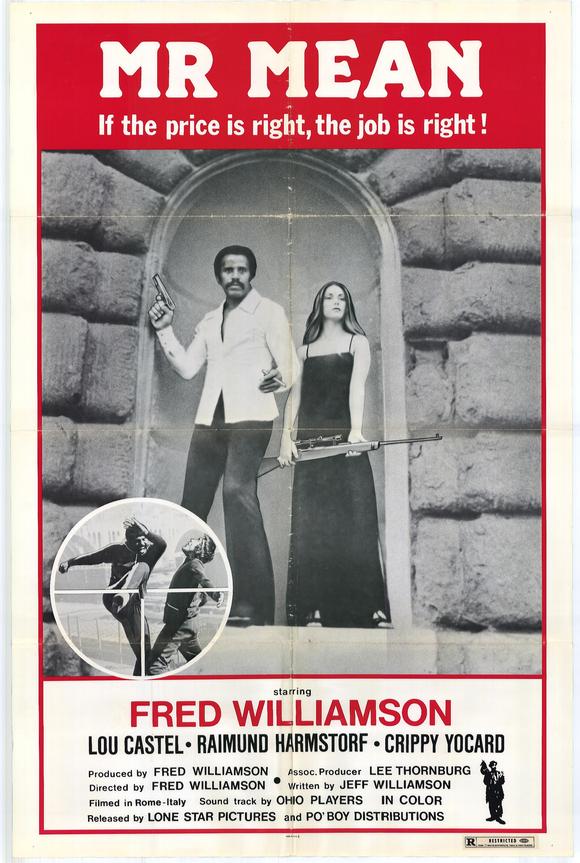
Blaxploitation Poster Gallery [Part 3]
Mean Johnny Barrows (Fred Williamson, 1976)
Mean Mother (Al Adamson, Leon Klimovksy, 1974)
The Monkey Hustle (Arthur Marks, 1976)
Mr Mean (Fred Williamson, 1977)
Sunday, 10 February 2013
Blaxploitation Poster Gallery [Part 2]
Cool Breeze (Barry Pollack, 1972)
Cotton Comes to Harlem (Ossie Davis, 1970)
Darktown Strutters (William Witney, 1975)
Death Dimension (Al Adamson, 1978)
Saturday, 9 February 2013
Friday, 8 February 2013
No One Will Play With Me (1976)
Dir: WERNER HERZOG
Country: WEST GERMANY
This unusual and
obscure little film from Werner Herzog emerged in between his two feature films
The Enigma of Kaspar Hauser (1974)
and Heart of Glass (1976). The former
is quite rightly lauded as one of Herzog’s finest achievements, and introduced
the world to the bizarre talents of the non-professional actor Bruno S. The
latter was a challenging fable of prophecy and apocalypse, a highly stylised and
visionary film in which the director famously hypnotised the majority of the
cast members. It seems odd that Herzog would return to the short film at this
stage in his career. His previous short film was made seven years before and
was entitled Precautions Against Fanatics
(1969), and in that time he had achieved his international breakthrough with
feature films like Aguirre: Wrath of God
(1972), the aforementioned Kaspar Hauser,
and critically acclaimed documentaries such as Land of Silence and Darkness (1971) and The Great Ecstasy of the Woodcarver Steiner (1974), both of which
were made for West German television, but achieved wider distribution due to
the directors new found fame.
Tuesday, 5 February 2013
Sunday, 3 February 2013
Herakles (1962)
Dir: WERNER HERZOG
Country: WEST GERMANY
This short nine
minute film would be totally insignificant were it not for the fact that it
marked the debut to filmmaking of Werner Herzog. The barmy Bavarian was a mere
twenty years old when he wrote, directed, produced, and edited this somewhat
amateurish effort. It is fair to say that Herakles
was an exercise; an experiment on Herzog’s part to see if he could actually
make a film. But even at this early stage Herzog’s decision to shoot on 35mm
film shows that he had ambitions that far exceeded the humble nature of this
production. But Herakles was an
instructive lesson, especially for a young man who largely existed in a world
without cinematic reference points, and whose influences were extremely
limited. In this film Herzog explores the art of editing, and although Herakles is little more than an
editorial exercise, it does contain a few images that will be of interest to
Herzog enthusiasts.
Thursday, 24 January 2013
Soundtrack Gallery - The Films of Dario Argento
The Bird with the Crystal Plumage - Capitol Records US LP Cover (1970)
Cerberus US LP Cover (1981)
Cinevox CD Cover (1998)
Sunday, 20 January 2013
The Ruthless Four (1968)
Dir: GIORGIO CAPITANI
Country: ITALY/WEST GERMANY
AKA:
Chacun Pour Soi
Every Man for Himself
Sam Cooper's Gold
The Goldseekers
Country: ITALY/WEST GERMANY
AKA:
Chacun Pour Soi
Every Man for Himself
Sam Cooper's Gold
The Goldseekers
It’s
always a pleasure to discover a hidden gem, but unfortunately it is an
increasingly rare occurrence nowadays. This is especially so in a cycle as
dense and derivative as the Euro-Western. But my interest in the Euro-Western
was recently piqued again by the purchase of an excellent book called Any Gun Can Play, written by Kevin
Grant, and published by FAB Press in 2011. If hidden cinematic gems are rare,
then well written books on film are like goldust. The Ruthless Four (one of many titles it was released under) is one
such discovery, and the analogy with gold is appropriate, for the film charts
the damaging and corrosive effect, this particular precious metal can have on
human beings. There are certain themes and concerns that are endemic in the
Euro Western, and one theme this cycle returns to time and again is greed. This
theme is of course also present in both traditional American westerns, and the
revisionist westerns that followed in the wake of A Fistful of Dollars (1964). But the difference lies in the way
that this theme is presented. The traditional western always seeks to emphasise
the positive aspects of its principal themes, and greed exists as part of a
cross-current of themes that ultimately serve a redemptive plot. In many
European examples greed is the entire raison d’être of the film, with
screenplays often allowing no room for anything else, as they explore its
acidic effect.
Subscribe to:
Posts (Atom)


.jpg)